All posts by taggart@reiki-evolution.co.uk

Reiki teaching: How to Create your Reiki manual

create your reiki manual

Your students need to relax, safe in the knowledge that everything you say on their Reiki course is covered in detail in their course materials. You should lay out everything that you teach, clearly and logically, with summaries, illustrations or images, and expand on what you teach on the day, providing non-essential but useful information that rounds out and deepens their knowledge of the system that they are learning.

Your students should not be forced to take notes because this is a huge distraction, stops them from enjoying the day, and trying to take decent notes when you’re all zonked out on energy is no fun.

So your students deserve a proper course manual that covers *everything* that you dealt with on the course, with further explanations, examples, and back-up info. They should be able to use your manual as a reference work that they can return to again and again to check on everything that is needed for that level.

You start with your notes

Your Reiki manual should start with what you tell students on their live course, so at the very least they have a hard copy of everything that you say to them, to refer to after their course. They won’t be able to remember, or take notes on, everything that you said to them, after all.

So you can base your manual on the notes that you made when you put your live course together. Write down everything that you think you say to people during your course and that can give you a basic lot of content to work with.

And because your notes will follow the basic order of your course, your manual will also follow that logical structure, which is helpful.

But when you teach, live, you will probably say more than you just jotted down in your notes: you will probably expand on things, give different real-world examples of people that you have treated, for example, to illustrate different points. I would hazard a guess that all of that won’t be there in your notes.

But all these things need to go in your manual, too, to make sure that it is comprehensive and detailed: a true resource for your students to be able to refer to and rely on. So how do you make that happen?

Record yourself when you present your course

Use a hand-held audio recorder to record yourself during your courses. You may not like listening to the sound of your voice but (a lot of people don’t) but you just need to get over yourself and do it anyway(!), because your manual will be so much more useful because of it.

Anything that you explain on a course, that you haven’t already noted down, you should write down now: all the anecdotes, all the explanations, all the descriptions and helpful practical suggestions that you make: add all of these to your manual.

But when we teach Reiki, often new topics of conversation arise. Students come up with so many different questions that you hadn’t prepared for and for which there are no answers in your notes: you have to deal with queries and issues ‘on the fly’, using your knowledge and experience there and then to help your students to be clear about what they should do. This is a very useful resource for you.

Using students’ questions to guide your content

Can you remember what interesting question or questions someone asked you the last time you taught Reiki? Maybe you made a note of them somewhere. You can put those answers or that issue in your manual to make sure that if anyone else wondered about that topic, you already have it covered.

Think back on other courses you held (or even courses that you attended when you were learning Reiki) and see if you can remember what interesting points and issues came up. All these issues can go in your manual.

But maybe you haven’t taught any Reiki courses yet; maybe you are getting your manual together in advance, ready for your first course or courses. That’s ok, because your manual should not be set in stone…

Making your manual a work in progress

Your Reiki manual does not have to be set in stone, a once-in-a-lifetime achievement that is never altered or changed once you have completed it. It would be more useful for you to see it as a work in progress, and manual that is ‘good enough’, but not there quite yet.

So as you carry on teaching Reiki, and have to deal with further interesting questions and queries, or areas where people seem confused or need further explanations to really ‘get it’, you can put all those explanations in your manual, adding to it every few weeks. Over time, you will answer more and more of your students’ questions, each time making your manual more and more comprehensive and useful.

And while we’re talking about making your manual useful, there is something that you can do that will really help your students, which is to…

Give your students options and choices

Now, there is no ‘one true way’ when it comes to Reiki, so suggest different ways that people can do a meditation or a self-treatment or a treatment of someone else. If you do that, you can encourage your students to experiment and find out for themselves what works best for them.

This is a good thing because you are allowing them to develop some flexibility in their approach and giving them ownership of the process.

So explain to them various self-treatment methods, and show how they can treat others in different ways, for example: short blasts on someone’s sore back at work, head/shoulder treatments on someone sitting in a chair, and full treatments on someone lying on a treatment couch.

Using anecdotes, case studies and testimonials

The most powerful way to illustrate and emphasise the main points that you want to get across to your students is to use stories about real people that you have worked with – either whom you have treated or whom you have taught.

So if you are talking about the effects that Reiki can have on people who receive a course of Reiki treatments, illustrate this by talking about the experiences of some of the people that you have treated. You don’t need to identify them by name, but you could say that you treated a lady once who had a problem x and this is what happened.

If one of your clients has given you a testimonial to use, where they talk about what their problem was and how Reiki helped them, you could use that, too, by way of backing up what you are saying.

If you are talking about how being attuned to Reiki can often bring things to the surface to be released, giving students a bit of a rough ride for a while, you could talk about the experiences of someone you have taught, or quote some feedback that they sent you, where they talk about their ‘Reiki cold’ or their emotional ups and downs etc, or where they talk about their sudden desire to de-clutter their house or simplify their life.


Need some help with your course materials?

reiki first degree course book cdI have put together comprehensive and detailed course manuals and easy-to-listen-to audio CDs with commentaries and guided meditations. All these are available for you to use on your own courses (no matter what lineage you have) and you can order them in packs of four at greatly discounted prices.

Reiki teachers all over the world are using them.

Find out more by clicking here:

Reiki Evolution Manuals and audio CDs.


Did you like this blog?

If so, you are going to love this book…
 

Teaching Reiki

“Spot on! I’ve been teaching reiki for many years and I must say I wish this book had landed back then!

I’ve put together courses and really would have loved a book like this to refer back to, it’s concise, clear, laid out really well and is informative and a mini support system to boot.

If you’re entering the Reiki world with an aim to become Master/Teacher then having this book in your armoury will benefit you.”
S J Price

Teaching Reiki

A Comprehensive Guide to Running Great Courses

This is the book I really wish had been available when I started running Reiki courses in 1997. And it would have helped me greatly in my journey as a Reiki teacher thereafter.

You’ll find a wealth of advice about how to set up and run your Reiki courses: read articles about planning and structuring your courses; find out how to explain things to students in a way that honours their learning preferences and personality types; discover how to create top quality course materials and how to support your students long-term.

We look at the differences between ‘Western’ and Original Japanese Reiki and I explain how I created “Reiki Evolution” courses, which pass on the essence of Reiki’s original form. Read this book and you’ll know how to teach “Reiki Evolution” style: what to say, what to teach, and even how to teach Reiki in a ten-week ‘Evening Class’ format.

This book will be of interest to anyone who is about to start teaching Reiki, or to established Reiki teachers who are interested in enhancing the quality of their courses.

Read the contents list before you order, if you like, by clicking on this link: Table of contents

Book: 370 pages.

Price: £15.99 + p&p


Or Download a PDF version now for only £12.49


Photo credit: Giuseppe Milo

Save

How to Use Symbols if you can’t Visualise Well

problems visualising reiki symbols

In my blog post A Simple Way with Reiki Symbols I describe a simple meditation method for experiencing the energy that a Reiki symbol (or any other symbol, for that matter) creates. I suggest that you take a quick look at that post before reading on.
 
Using visual images works quite well for probably the majority of people (so it’s a useful first port of call, and all Reiki courses, of course, include symbols at Second Degree and beyond), but there are a fair number of people where it’s not such a good fit.
 
Mikao Usui got round this by using various approaches with his students. One method he used was to teach Shinto mantras called ‘kotodama’, where students used sounds, chanting, to become the energies of earth ki and heavenly ki, and to experience a state of oneness. He taught the kotodama to far more of his students than received the Reiki symbols that are taught routinely in the West. Dr Hayashi was taught the symbols, though, and they were passed on to the West via Mrs Takata.
 
So graphical images are not the only way of experiencing the energies.
 
But let’s see what we can do with the graphics, just for a little while longer…

Many people can’t visualise so brilliantly, anyway!

Many people who aren’t very good at visualising things imagine that people who can visualise can see things in Ultra HD, Technicolor, Panavision, with perfect, infinite detail and fantastic colour resolution. Sadly, that’s not the case! Visual memory is a bit rubbish, really, like the digital images you used to get on the very first mobile ‘phones that came with cameras: grainy and indistinct.
 
So most people who use visual images of the symbols won’t be able to see the images clearly for more than a few moments, and won’t keep the symbols clearly in mind as they experience the energy; rather the image is flagged up there to set an intent about the nature of the energy that you want to channel.
 
Sometimes people will re-draw the symbol if they feel they need to, but most of the time they are just drifting in a meditative state, channelling the energy that they intended to.
 
But it is possible to experience the symbols in more of a ‘physical’ sense. Let me explain…

Feeling a symbol instead of seeing it

Say that you had your eyes shut and you imagined that you were hovering in the air above some railway lines.
 
Even though you couldn’t see them, you could become aware of the physicality of those lines, couldnt you?: their solidness, their density. And if those lines took a sharp turn right below you, or a squiggle, you could become aware of the physical nature of their contours and direction, without having an image come to mind.
 
Try that. Notice what you can feel or sense in a physical way. 

Experiencing a symbol through muscle movements

Also, if you practise drawing out a symbol, quite flamboyantly, using your hand/arm, with a bit of repetition you could remember those movements (your muscle memory) in the same way that you can probably now remember and duplicate the finger-movements that you use when entering your PIN into a card machine at the supermarket or cash machine.
 
There is a physical memory of the movements that you can trigger in your mind. You can almost feel the necessary muscles firing off as you imagine making those familiar movements.
 
Try that now: type your PIN into a cash dispenser in your mind; do that repeatedly. Don’t actually move your real fingers, but experience those movements in a physical way.
 
Notice the messages firing off to your muscles, feel the shape and the movement, the pattern.

Feel that symbol through muscles and density

So if you did those two things: making imaginary hand movements and becoming physically aware of the solidity and contours of a symbol… there you have a way of experiencing a symbol in a non-visual manner.
 
Try that. Put that symbol up there above you, use those muscle movements in your mind, experience the physical density and contours of the symbol, and once the solid, dense contours of the symbol are there before you, have in mind that the energy is flooding down to you from that 3D shape… and let the energy flow.

Over to you

If you have had problems with visualising symbols, why not try this different approach and ‘see’ how you get on. Does this make working with symbols easier for you?

Did you like this blog?

If so, you are going to love this book…


Liberate Your Reiki!

“Whether you are at Level 1, 2 or Reiki Master Teacher Level (regardless of the Reiki flavour you are trained in), this book is very much for you! Within hours of starting to read this book, it has rejuvenated and enriched my own practices with a wealth of information and useful examples too.

The more you read the more you’ll have those wonderful ‘aha’ moments. I know I am already benefiting personally from the knowledge I’ve gained, but so will all my family, friends and clients too. Thank you Taggart for creating this incredible, uniting, enlightening book.”

Heidi Gaffney-Evans

Liberate Your Reiki!

86 Articles About Reiki: One Inspiring Vision

In this Reiki book you will find 80+ articles about Reiki, written by Reiki Master Teacher Taggart King. You will discover how to set your Reiki free, free from the constraints, dogma, rules and regulations of Western-style Reiki courses. Get back to Reiki’s original Japanese method and embrace simplicity, flexibility, creativity and intuition.

This book is suitable for people at all Reiki levels: beginners, those who are developing their Reiki, and Reiki Masters/Master Teachers. You will find advice about self-treatment meditations, energy exercises to build your ability as a channel, you will discover how to work with your intuition and embrace the power of intent.

Explore different distant healing methods and discover the beauty of Reiki’s original Japanese form. Learn how to use creativity and visualisation to enhance your self-treatments and treatment of others, and ditch all the silly rules and regulations that stifle the practice of Western Reiki in many lineages.

Finally, read Taggart King’s “10 Rules of Reiki”, the essential principles for a powerful and fulfilling Reiki practice.

This professionally-printed Reiki manual has 370 A5 pages, a glossy soft cover and we will send it to anywhere in the world!

Read the contents list before you order, if you like, by clicking on this link: Table of contents

Book: 370 pages.

Price: £15.99 + p&p


Or Download a PDF version now for only £12.49


Picture credit: youflavio
 

Reiki teaching: using the right 4MAT

reiki teaching myers briggs 4MAT system

That is not a spelling mistake: I did intend to spell the word ‘format’ in that way! The “4MAT” system is a way of approaching teaching that was created by Bernice McCarthy and proposes that there are four major learning styles, each of which result in a student asking different questions and displaying different strengths during the learning process.

The 4MAT system is based on Myers-Briggs personality typing, which break people down into different categories, for example Introvert and Extrovert.

I am not going to go into detail here about the different categories (you can read up about those for yourself if you’re interested) but beyond Introvert/Extrovert there are three other pairs of categories:

  • Sensor/Intuitor
  • Thinker/Feeler
  • Judger/Perceiver

Myers Briggs uses these labels to create four-letter abbreviations for particular personality types, so someone might be an “INFJ”, an Introvert, Intuitor, Feeler, Judger. Myers Briggs aficionados will know immediately what sort of a person that is!

But let’s get back to teaching and Reiki…

The four 4MAT categories

The 4MAT system describes four different types of learners, all of whom require different things in order to best assimilate information. If your teaching style, the things that you say, the issues or topics that you cover, do not match the needs of a student, they are likely to feel dissatisfied or will not take in the information so well, or they may feel disengaged with the topic.

And the challenge is that, since we all fall into one particular category ourselves, we are likely to naturally emphasise what we need as a learner, when we teach other people. This will be fine for students whose 4MAT category matches our own, but won’t be so helpful to those who have different needs.

So by deliberately and carefully considering the 4MAT categories we can make sure that we routinely satisfy the needs of these four ‘flavours’ of learner,. In doing that, we can make sure that all out students’ learning needs are satisfied, leaving them more engaged and better served by our teachings, and we then make what we provide as a teacher more comprehensive and powerful.

Here are the four types:

The Concrete-Random learner

This learner needs to know “Why?” they are learning a particular thing, why they should be involved in a particular activity. What is the point of all this?

The Abstract-Sequential learner

This learner needs to know “What?” to learn: exactly what do they need to know? They need to see it in black and white; it shouldn’t be vague and wishy-washy. There shouldn’t be unanswered questions.

The Concrete-Sequential learner

This learner wants to know “How?” to apply the information they are being presented with: what do you actually do with this information in practice?

The Abstract-Random learner

This learner wants to answer “What If?” questions about how they can modify what they have learned to make it work for them.

Using 4MAT in practice

You can use the four questions – Why?, What?, How? and What If? to guide you when teaching a course or teaching a particular technique or practice.

If you deal with these four different questions, you make the learning accessible to the four major categories of learners, make what you teach memorable and ensure that you leave no-one behind.

These four questions can be cycled through again and again for each section of your course. Let’s think of an example: say, the teaching of Hatsurei ho (daily energy exercises used in Japanese-style Reiki).

This is how the teaching of it, 4MAT-style, might look like:

Hatsurei ho teaching, 4MAT-style

Why do we do Hatsurei ho? What is the purpose of it and what are our goals in carrying it out?

What do we actually do when we perform Hatsurei ho? What are the stages, what precisely will we do in what order? What do we need to know in order to perform Hatsurei ho effectively?

How do we do Hatsurei ho? This would be a good time to talk your students through the process and talk about when to do Hatsurei ho, how often, and what happens if you miss a day.

Finally, how can you modify Hatsurei ho and use it in different contexts? This is the “What If?” stage: you might talk about separating out Kenyoku and using it for cleansing/clearing prior to starting a Reiki treatment, or in other situations. You might also talk about using just Kenyoku and Joshin Kokkyu ho, a shorter sequence which comes closer to what Usui Sensei was teaching to his students in Japan.

That’s not a bad sequence to keep cycling through, is it?

You can introduce a topic or exercise by explaining why you would want to go through this exercise, you move on to explain in detail exactly what the exercise is, you describe how the exercise is used in practice and then finish by exploring different ways in which the exercise can be used, in different contexts and situations.

So you can see that the 4MAT system provides you with a way of being comprehensive with your teaching of each chunk of your course, while meeting the learning needs of all your students.

Over to you

Why not look at the different things that you teach on your Reiki courses, and see how well your presentations, descriptions and demonstrations meet these four learning criteria.

How could you alter what you say and do to follow the 4MAT system in these examples?

  • Self-treatments
  • Head/shoulder treatments
  • Distant healing
  • Using the Reiki symbols
  • Working intuitively


Need some help with your course materials?

reiki first degree course book cdI have put together comprehensive and detailed course manuals and easy-to-listen-to audio CDs with commentaries and guided meditations. All these are available for you to use on your own courses (no matter what lineage you have) and you can order them in packs of four at greatly discounted prices.


Reiki teachers all over the world are using them.

Find out more by clicking here:

Reiki Evolution Manuals and audio CDs.


Did you like this blog?

If so, you are going to love this book…


Teaching Reiki

“Spot on! I’ve been teaching reiki for many years and I must say I wish this book had landed back then!

I’ve put together courses and really would have loved a book like this to refer back to, it’s concise, clear, laid out really well and is informative and a mini support system to boot.

If you’re entering the Reiki world with an aim to become Master/Teacher then having this book in your armoury will benefit you.”
S J Price

Teaching Reiki

A Comprehensive Guide to Running Great Courses

This is the book I really wish had been available when I started running Reiki courses in 1997. And it would have helped me greatly in my journey as a Reiki teacher thereafter.

You’ll find a wealth of advice about how to set up and run your Reiki courses: read articles about planning and structuring your courses; find out how to explain things to students in a way that honours their learning preferences and personality types; discover how to create top quality course materials and how to support your students long-term.

We look at the differences between ‘Western’ and Original Japanese Reiki and I explain how I created “Reiki Evolution” courses, which pass on the essence of Reiki’s original form. Read this book and you’ll know how to teach “Reiki Evolution” style: what to say, what to teach, and even how to teach Reiki in a ten-week ‘Evening Class’ format.

This book will be of interest to anyone who is about to start teaching Reiki, or to established Reiki teachers who are interested in enhancing the quality of their courses.

Read the contents list before you order, if you like, by clicking on this link: Table of contents

Book: 370 pages.

Price: £15.99 + p&p


Or Download a PDF version now for only £12.49


Photo credit: Tim Pierce

Save

Reiki teaching: using learning preferences

People learn in different ways. When we learn we take in information through our senses, so we see things, we hear things, we learn through doing and we mull things over in our mind. The best learning comes when you provide people with training that engages with all these aspects.

Some people tend to prefer one approach over the others, so you might find that one person much prefers to listen, whereas another might really need to see something before they ‘get it’, while yet others need to do practical things, to move, to really understand and remember what they are being presented with.

In NLP (Neurolinguistic Programming) these preferences are called being visual, or auditory or kinaesthetic. There is another preference, too, when people are referred to as ‘audio digital’: these people need a strong sense of order or logic before things sink in properly for them.

I am quite a visual person, so I like diagrams, I think in pictures (not everyone does), I use Mind Maps, my written notes are quite visually diverse and sometimes flamboyant. I need that visual input more than, say, listening to something. And I have a great need for logic and order.

“The SatNav episode”

This was brought home to me several years ago when I was training in NLP and my wife Lorraine and I were going somewhere fairly local that we had not been to before. We had the SatNav on but hadn’t bothered to attach it to the windscreen; Lorraine had it resting in her lap and she looked at it and told me where to go.

Lorraine prefers the auditory sense so it made sense to her to just call out the instructions to me on this fiddly route; she said that I didn’t need to see the screen. I thought that I didn’t… But I did! I really did! It was excruciating for me to travel without seeing a map of where I was going.

I had to stop the car in the end and look at the SatNav screen so I could *see* where I was. Once I had seen the territory it all made sense and I understood where I needed to go.

I needed to see to understand, whereas Lorraine didn’t have that need.

When I give directions to someone I always want to reach for a scrap of paper so I can show someone; they might respond, though, by saying “just tell me!” My mind will be saying, “it’s much better if I can show you.”

But for them it may not be…

Don’t assume everyone is just like you

The problem comes because we tend to assume that the way we learn is they way that everybody learns. So if you learn by listening, you might run a course where you spend most of your time talking, and there will be students who are desperate to see something demonstrated, or to see a diagram, or to have an overview of what they day will entail, or to see the logical links between things, or to try something out for themselves, to ‘get their hands dirty’.

So by running a course where you show things, you talk about things, you supervise people practising stuff, and you make sure that your day flows logically from one thing to another, you are providing your students with the very best training.

You are touching all bases and making sure that the course meets the learning preferences of all your students.

And by touching all bases, you actually make the learning more meaningful and effective for everyone, because the best learning uses sights, sounds and physicality, no matter what someone’s preference might be. So a ‘visual’ learner like me needs images, but I will learn better if I also get to hear and to do.

Making your courses touch all bases

  • On a live course it is straightforward to make sure that you are touching all bases: On a First Degree course, for example:
  • Talk to them about Reiki and about the exercises they will be carrying out
  • Show them what they will be doing when they perform the movements of Hatsurei ho and a Self-treatment
  • Have them go through the physical movements with you
  • Make sure they have seen you make the movements and practised the physical movements for themselves before they close their eyes for you to guide them with your voice

When dealing with the subject of treating other people, you can talk about the subject and then you can give a visual demonstration of the hand positions, talking to your students when you do that to give hints and tips and useful advice. They then go through the hand positions themselves, guided by your voice.

Teaching materials to use on the day

You might consider having some display boards set up, with colour photographs demonstrating full treatment hand positions. Your students will take the information in subconsciously during the day.

On my Reiki Master Teacher live courses I used to have display boards set up which showed the stages of giving Western-style attunements. They can see the visuals as you talk them through the process, then you give them a visual demonstration, then they go through the movements themselves with you or another student talking them through the stages.

I even had some A3 sheets and marker pens so students could draw little diagrams to explain the attunement stages, and I also had students sit down and talk each other through the process.

So I was engaging with all senses: they looked and were were watching, they listened and they explained; it is very powerful having someone explain something to another person because you have to have things well-ordered in your mind in order to do that. They created visuals and they carried out physical movements while receiving spoken instructions.

All in all, a powerful learning combination.

Creating course materials that engage all senses

At Reiki Evolution we use detailed and comprehensive course manuals containing text, summaries and photographs. The manuals are well ordered and logical and students get to read about the experiences of many other students that have been through this training.

Along with the printed manual, students for First Degree also receive separate “at a glance” summary sheets with lots of photographs to illustrate the stages of carrying out Hatsurei ho, giving a Self-treatment, and some Full treatment hand positions.

I include some blank ‘cartoon strip’-style squares for them to do little drawings, perhaps just with stick figures, to illustrate the treatment hand positions, to jog their memory. I also include a set of “20 Reiki questions”, the answers to which they are expected to search for in their course materials, and I include a separate sheet with the answers that they can look at to check their discoveries.

We provide audio CDs with commentary (just like listening to a Reiki training course, but something that you can play again and again) and we also provide guided meditations, talking students through their daily energy exercises, a self-treatment meditation, a distant healing meditation and a Reiki symbol meditation.

You can see why we do that, can’t you? We provide logic and order, we provide written information, summaries and images, we provide short talks you can listen to and we give you the chance to be guided as you put Reiki into practice on yourself and with other people.

Engaging with people’s different learning preferences, and ensuring that your live course and your training materials are multimedia, leads to the most powerful and effective learning.

Need some help with your course materials?

reiki first degree course book cdI have put together comprehensive and detailed course manuals and easy-to-listen-to audio CDs with commentaries and guided meditations. All these are available for you to use on your own courses (no matter what lineage you have) and you can order them in packs of four at greatly discounted prices. Reiki teachers all over the world are using them. Find out more by clicking here:

Reiki Evolution Manuals and audio CDs.


Did you like this blog?

If so, you are going to love this book…


Teaching Reiki

“Spot on! I’ve been teaching reiki for many years and I must say I wish this book had landed back then!

I’ve put together courses and really would have loved a book like this to refer back to, it’s concise, clear, laid out really well and is informative and a mini support system to boot.

If you’re entering the Reiki world with an aim to become Master/Teacher then having this book in your armoury will benefit you.”
S J Price

Teaching Reiki

A Comprehensive Guide to Running Great Courses

This is the book I really wish had been available when I started running Reiki courses in 1997. And it would have helped me greatly in my journey as a Reiki teacher thereafter.

You’ll find a wealth of advice about how to set up and run your Reiki courses: read articles about planning and structuring your courses; find out how to explain things to students in a way that honours their learning preferences and personality types; discover how to create top quality course materials and how to support your students long-term.

We look at the differences between ‘Western’ and Original Japanese Reiki and I explain how I created “Reiki Evolution” courses, which pass on the essence of Reiki’s original form. Read this book and you’ll know how to teach “Reiki Evolution” style: what to say, what to teach, and even how to teach Reiki in a ten-week ‘Evening Class’ format.

This book will be of interest to anyone who is about to start teaching Reiki, or to established Reiki teachers who are interested in enhancing the quality of their courses.

Read the contents list before you order, if you like, by clicking on this link: Table of contents

Book: 370 pages.

Price: £15.99 + p&p


Or Download a PDF version now for only £12.49


Photo credit: Fons Heijnsbroek

Reiki teaching: what are your goals?

reiki teaching goals

When you are starting to teach Reiki courses and are planning what you are going to cover, demonstrate and say, it is very important that you start with a clear idea of what you’re aiming for: your goals.

Goals can encompass what information you want your students to have taken on board and understood, what practical exercises you want them to have been through, and feel comfortable with, and what ‘Reiki worldview’ you want to instil. I will talk more about this last item further down the page.

Knowledge goals

Most teachers will want their students to have a fairly good idea about:

  • What Reiki is
  • Where it comes from
  • What Reiki can do for them if they work with the energy and the precepts regularly
  • What Reiki can do for other people when they receive Reiki treatments

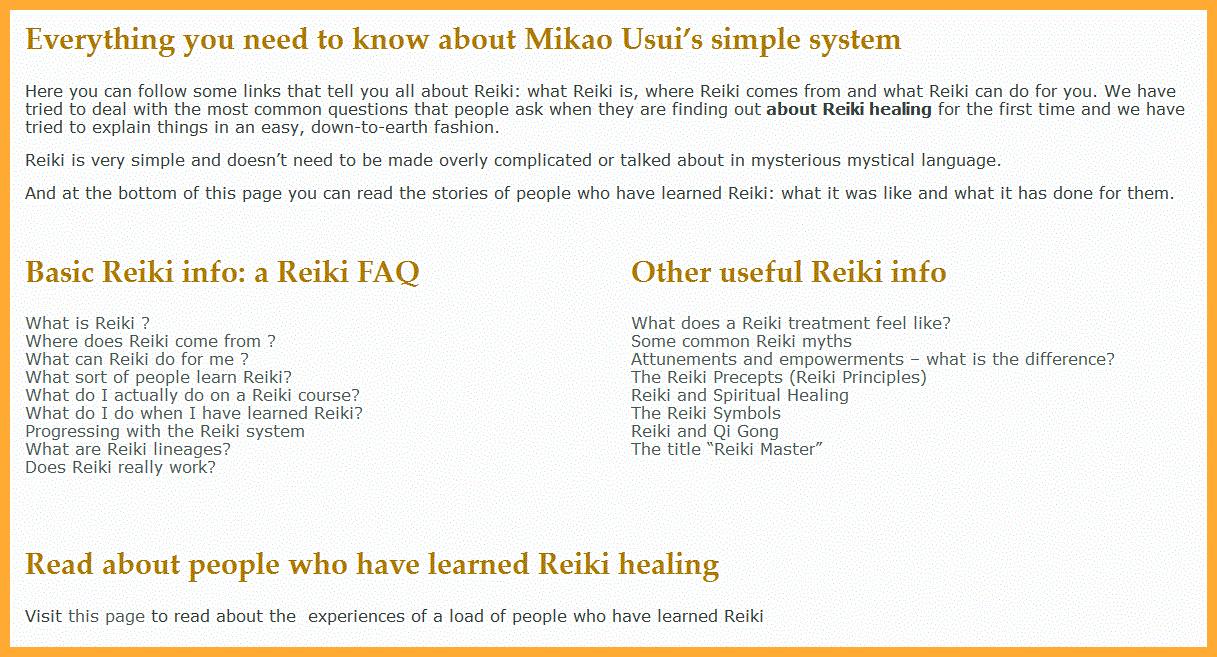
This information can be made available on a web site, so potential students can find out about these areas even before they book on a course. So, for example, the “About Reiki Healing” page of this web site starts with this text:

Reiki is a simple Japanese energy system anyone can learn

  • Experience peace of mind and inner calm
  • Relieve stress and anxiety
  • Bring a sense of balance and wholeness
  • Help family and friends
  • Explore your spiritual side
  • Let go of emotional baggage

Further down the page I include links that people can follow to find out more about a whole range of issues to do with Reiki, which you can see below in this screen shot (please note, this is an image and nothing is clickable):

If you have your own web site and would like to be able to refer to these articles, please include a link from your web site to any of these pages. Don’t copy and paste the text into your own site, though, because Google won’t like that and will penalise your site.

Then the information can be repeated, rewritten or summarised in your course materials (your manual, maybe on an audio CD). You will see in my blog Reiki teaching: your course materials that I recommend that you send your course materials out to your students in advance so they can take their time and mull over this information, and re-visit it several times before arriving on your course, and this means that they day of your course can involve you just re-capping the main points, rather than trying to tell everyone everything, for the first time, on a course where your students are half-zonked-out on the energy and in the worst position to be able to assimilate new information!

How to work out what to tell them

There is a lot of information out there to do with Reiki and it can be difficult sometimes to see the wood for the trees. What do you tell them? What should you start with?

To get some focus, ask yourself this question for each category of information (what Reiki is, where Reiki comes from, What Reiki can do for you etc):

  1. If I could only tell my students five things, what would they be?
  2. If I had to blurt out the basic info in a 30 second conversation with someone while travelling in a lift, what would I blurt out?

These questions give you an idea of the priorities, the main themes, and then you can expand on these themes and provide additional supporting info and examples. I talk more about this in Reiki teaching: explain, guide and review.

Practical goals

Here is where you decide what practical exercises you want your students to go through on your course, what they need to feel comfortable with, and what they need to understand about what they are doing.

For a First Degree course you might want to focus on:

  • Experiencing energy between your hands and around someone else’s hands
  • Feeling energy around someone else’s head and shoulders
  • Carrying out Hatsurei ho
  • Performing a self-treatment
  • Practising scanning
  • Giving a full treatment
  • Receiving a full treatment

For a Second Degree course you might want to focus on:

  • Experiencing the energy of earth ki
  • Experiencing the energy of heavenly ki
  • Using these two energies to treat someone
  • Sending distant healing
  • Practising working intuitively
  • Exploring use power of intent through visualisation

For each of these, decide what you want them to do, precisely, and how you are going to explain and talk people through these exercises?  Work out what you need to the student to understand about what they did. What do these exercises mean for them, why are they important, how will they use them in practice and what might they notice when they carry out these exercises in the coming weeks and months?

More ‘global’ goals

In a wider sense, my goal is to create independent Reiki practitioners who are comfortable working with the energy, flexible and intuitive in their approach, not attached to dogma, not judgmental of other people’s different ways of practising Reiki, and not dependent on me as a teacher to dispense all the answers.

I hope that they should be able to embrace uncertainty, following a Reiki path as a journey of self-development, not believing that what they were taught is the ‘one true way’ or the ‘absolute truth’.

In my blog My Manifesto for Reiki Tolerance I spoke about how Reiki is a very flexible and accommodating system and acts as a ‘carrier’ that accommodates very many different ways of working, some simple, some more complex. I spoke about how some ways of working naturally attract some people, while for others a different way of working feels more ‘right’ for them.

I hope that my students will not treat the Reiki Evolution approach as ‘the one true way’ and look down on or disparage other practitioners’ methods, even though it is not uncommon for some Reiki people to behave in this way.

I want to promote tolerance and respect and compassion for others and I believe that they way that I and my team of teachers speak about Reiki promotes this.


Did you like this blog?

If so, you are going to love this book…


Teaching Reiki

“Spot on! I’ve been teaching reiki for many years and I must say I wish this book had landed back then!

I’ve put together courses and really would have loved a book like this to refer back to, it’s concise, clear, laid out really well and is informative and a mini support system to boot.

If you’re entering the Reiki world with an aim to become Master/Teacher then having this book in your armoury will benefit you.”
S J Price

Teaching Reiki

A Comprehensive Guide to Running Great Courses

This is the book I really wish had been available when I started running Reiki courses in 1997. And it would have helped me greatly in my journey as a Reiki teacher thereafter.

You’ll find a wealth of advice about how to set up and run your Reiki courses: read articles about planning and structuring your courses; find out how to explain things to students in a way that honours their learning preferences and personality types; discover how to create top quality course materials and how to support your students long-term.

We look at the differences between ‘Western’ and Original Japanese Reiki and I explain how I created “Reiki Evolution” courses, which pass on the essence of Reiki’s original form. Read this book and you’ll know how to teach “Reiki Evolution” style: what to say, what to teach, and even how to teach Reiki in a ten-week ‘Evening Class’ format.

This book will be of interest to anyone who is about to start teaching Reiki, or to established Reiki teachers who are interested in enhancing the quality of their courses.

Read the contents list before you order, if you like, by clicking on this link: Table of contents

Book: 370 pages.

Price: £15.99 + p&p


Or Download a PDF version now for only £12.49


Photo credit: Intel Free Press

Reiki teaching: supporting your students

giving support to reiki students

One of the things that we hear about quite a lot from people who come to Reiki Evolution, having taken a Reiki course before with a different teacher, is that they were never able to get in touch with their previous teacher to ask questions or ask for advice. They felt left out on a limb.

Either the teacher never got back to them, or the student had the impression that the teacher was ‘too busy’, or the student felt intimidated and didn’t want to ‘bother’ their Reiki teacher.

That’s not very good, is it?

So in this blog I thought I would talk a bit about the different ways that we can support our students.

Decent course materials and training

The first way that we can help our students to have a great Reiki experience is to make sure that we deal with the common questions that students ask, on our live courses and in our course materials.

When I first started to teach Reiki my students had a lot of questions, and what I did was to remember what a student had asked and make sure that I provided the answer to that question the next time I ran that course, so that over time my courses because more and more helpful, and my course materials because more and more comprehensive.

Over time, I found that the number of questions I received reduced because I was answering them all in advance!

Be happy to help

Make it clear to students that you are happy to answer any questions that they might have, once they have completed their training. Have a state of mind of being friendly, open and supportive and your students will pick up on that.

I tell people that the only stupid question is the question that you do not ask, where you still have this need to have something explained to you, running round your head. That would be the stupid thing!

Now that does not mean that you have to be the source of all Reiki knowledge, on tap, available 24/7. You don’t want students asking you questions that are right there in their manual. You can refer them to sources of information, like sections of your manual, or blog posts that you have written, or give them links to web sites etc.

And not all questions are answerable anyway, or the answer might be “who knows?” or “who knows, and it doesn’t really matter anyway”

Remember that you are not the source of all Reiki wisdom that your students need to consult for answers about everything: we should not encourage students to be dependent on us as teachers.

You initiate them and they set out on their own journey of discovery and experimentation.

But having said that, you should do what you can to point them in the right direction and keep them focused on the important aspects of Reiki.

Reiki shares

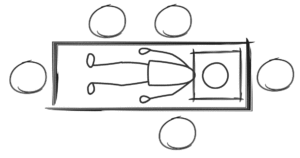
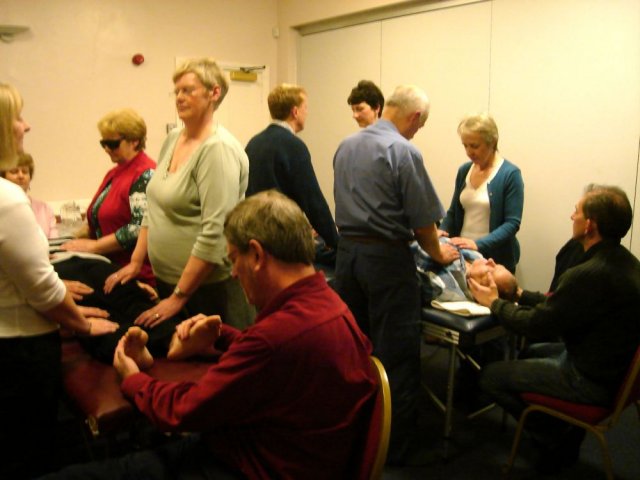
At their most basic, Reiki shares are Reiki get-togethers where you meet other Reiki people and swap Reiki treatments. If there are a fair number of people attending, everyone takes a turn on the treatment table and can end up being treated by multiple practitioners: you might have one person sitting at the head of the table, someone by your ankles and people on either side of the table too.

Receiving a Reiki treatments from lots of people at the same time is an *amazing* experience!

Highly recommended.

Sometimes the Reiki share host (it doesn’t have to be a Reiki Master but often is) will talk people though some energy exercises (for example kenyoku followed by Joshin Kokkyu ho) and give attunements (or ideally Reiju empowerments) to everyone present.

If there are several Reiki Masters present, they could ‘share out’ the empowerments and do a few each. This is ideal if there are new Reiki Masters there who want to practise giving empowerments to people.

Sometimes there might be a further guided meditation or a group distant healing session or a chat about people’s experiences when treating other people, say.

You can do what you like.

Set a particular date, say the first Thursday in the month at 7.30pm, or the second Saturday at 2pm, and see what happens.

Reiki practice days

This is a variation on a Reiki share where people have the opportunity to give and receive full Reiki treatments, in pairs, while under the supervision of a Reiki teacher, and is ideal for people who have taken a First Degree course, say, and who haven’t had too much of a chance to treat other people, or people who learned Reiki some time ago and now want to get going properly and build their confidence.

The day could again start with some energy exercises and empowerments, and could include a question-and-answer session.

Online support networks

I am a great believer in students providing support to each other, rather than feeling that they have to be dependent on their teacher. Everyone has useful experience that they can share with each other. The Reiki teacher does not know everything, after all.

There are different ways of providing such support, some simpler than others, for example:

A Yahoo! Group – click here for info

A NING site – click here for info

A Facebook group – click here for info

In all these examples, students are able to talk to each other, whether that is through swapping email messages with the whole group (Yahoo!), chatting one-to-one or posting videos and images.

Groups like this can build a tremendous sense of community and you can be sure that if one person posts a question, there will be many other students who were wondering about that too, but didn’t ask!

People will share their successes, their amazement, their awe and enthusiasm and the interesting things that have happened to them and to the people they treated. Some will talk about the changes the have noticed within themselves since starting to use Reiki regularly and how they precepts have altered the way they behave and feel about things and changed in the way respond to others.

Highly recommended.

And while to begin with, if you are just starting out as a teacher, you might only have a handful of students subscribed (and tumbleweed blowing through your chat rooms!) it won’t be too long before the numbers build up and you’ll have on hand a wealth of knowledge and experience that new students can draw upon.

Need some help with your course materials?

reiki first degree course book cdI have put together comprehensive and detailed course manuals and easy-to-listen-to audio CDs with commentaries and guided meditations. All these are available for you to use on your own courses (no matter what lineage you have) and you can order them in packs of four at greatly discounted prices. Reiki teachers all over the world are using them. Find out more by clicking here:
Reiki Evolution Manuals and audio CDs.


Did you like this blog?

If so, you are going to love this book…


Teaching Reiki

“Spot on! I’ve been teaching reiki for many years and I must say I wish this book had landed back then!

I’ve put together courses and really would have loved a book like this to refer back to, it’s concise, clear, laid out really well and is informative and a mini support system to boot.

If you’re entering the Reiki world with an aim to become Master/Teacher then having this book in your armoury will benefit you.”
S J Price

Teaching Reiki

A Comprehensive Guide to Running Great Courses

This is the book I really wish had been available when I started running Reiki courses in 1997. And it would have helped me greatly in my journey as a Reiki teacher thereafter.

You’ll find a wealth of advice about how to set up and run your Reiki courses: read articles about planning and structuring your courses; find out how to explain things to students in a way that honours their learning preferences and personality types; discover how to create top quality course materials and how to support your students long-term.

We look at the differences between ‘Western’ and Original Japanese Reiki and I explain how I created “Reiki Evolution” courses, which pass on the essence of Reiki’s original form. Read this book and you’ll know how to teach “Reiki Evolution” style: what to say, what to teach, and even how to teach Reiki in a ten-week ‘Evening Class’ format.

This book will be of interest to anyone who is about to start teaching Reiki, or to established Reiki teachers who are interested in enhancing the quality of their courses.

Read the contents list before you order, if you like, by clicking on this link: Table of contents

Book: 370 pages.

Price: £15.99 + p&p


Or Download a PDF version now for only £12.49


Photo credit: Anne Jacko


Reiki teaching: your course materials

woman reading reiki course materials

Imagine going on a Reiki course, say a First Degree course, for the first time. You don’t know anything about Reiki, really, and you’re not sure what is going to happen on the course. When you arrive, the teacher starts to tell you huge amounts of information about Reiki during your day. It’s difficult to take it all in – it’s all so new, after all, and you haven’t heard any of this stuff before. There are new ideas and concept to get your head around and you have lots of questions.

You try to take notes as you go along, but it’s a bit like trying to drink from a fire hose. You scribble away, and while you’re concentrating on what to write down you miss the next bit of what they are saying, and you can hardly replay what they just said! The attunements or empowerments you receive, while often wonderful experiences, don’t help either because they have made you feel all spaced out and blissful, and the energy work is zonking you out too, as you try and concentrate on what is being said.

There’s a lot to take in.

Then, at the end of the day, you get sent home with a cheery goodbye and two sheets of A4: one with your lineage and one with a bad photocopy of some treatment hand positions.

Reiki students deserve better than that.

So what I am going to talk about in this blog are two things that you can do to make sure that your students’ experience does not match what I described above.

You can:

  • Provide extensive course materials
  • Send out course materials to students in advance

Provide extensive course materials

Your students need to relax, safe in the knowledge that everything you say on their Reiki course is covered in detail in their course materials. You should lay out everything that you teach, clearly and logically, with summaries, illustrations or images, and expand on what you teach on the day, providing non-essential but useful information that rounds out and deepens their knowledge of the system that they are learning.

Your students should not be forced to take notes because this is a huge distraction, stops them from enjoying the day, and trying to take decent notes when you’re all zonked out on energy is no fun.

So your students deserve a proper course manual that covers *everything* that you dealt with on the course, with further explanations, examples, and back-up info. They should be able to use your manual as a reference work that they can return to again and again to check on everything that is needed for that level.

Give your students variations to experiment with: there is no ‘one true way’ with Reiki, so suggest different self-treatment methods, and show how they can treat people in different ways, for example short blasts on someone’s sore back at work, say, head/shoulder treatments, and full treatments.

Cover everything that you say on a live course, absolutely everything, and more besides, and deal with every question that a student has asked you so that what you provide is really comprehensive: a valuable long-term resource.

Your course materials will be a ‘work-in-progress’ for some time!

You should also deal with students’ learning preferences and make your materials multimedia, and I will talk about this more in a later blog.

Send your course materials out in advance

Many years ago when I first started teaching Reiki, I was talking to a Reiki Master that I met at a Reiki gathering or meeting and she mentioned to me that she always sent her students a Reiki manual in advance, before they arrived on the day of their course. My first reaction, because it was different to how I had been taught, was to think, “no, no, no, that’s all wrong!” but it didn’t take very long before I realised that, actually, that was a genius idea. I wish I could remember her name so I could thank her!

By sending a Reiki manual as soon as a student books on their course, they can take their time and read about Reiki, what it is and where it comes from, what it can do for them, how it can help people you treat, at their leisure. There is no reason why all this information has to be blasted at a student for the first time on the day of a course. They can mull over the information, think about it, search for answers to any questions that they might have, reflect on what they have read.

They will also read about the practical exercises that they are going to be guided through on their live course, so they will already be fairly familiar with Hatsurei ho (daily energy exercises), self-treatments and treating others in different ways.

Info is better assimilated over time, in manageable chunks, rather than trying to ‘drink from a fire hose’ on the day of a course.

In fact, when I send out study packs to my Reiki Evolution students, I include a couple of audio CDs, a sheet where they can note down their Reiki goals and their initial questions, and I also give them a list of 20 questions that they should be able to answer. I do this so that their subconscious is primed to look for those answers in the course materials, and once they have found the answers then they have focused on the main points or areas that I wanted them to focus on.

By doing this, when they arrive on their live course they are already quite clued-up about Reiki and what they are going to be doing on their live course.

This means that:

  1. The teacher does not have to spend their time sitting down telling the students stuff that they could have easily read about beforehand
  2. Students can spend most of their time on the live course actually doing stuff with energy rather than sitting hearing someone talk about, say, the history of Reiki
  3. The teacher can spend their time just recapping what the students are already familiar with, focusing the students on the main points and themes and thus reinforcing them

If you’re on a live course, it makes sense to make the time you spend count, to make it mostly about experiencing energy and practising using energy on yourself and on other people, rather than just sitting telling students stuff.

Reiki is a practical skill, after all, and rather like riding on a bicycle, you should spend your time practising it, not hearing about it!

Need some help with your course materials?

reiki first degree course book cdI have put together comprehensive and detailed course manuals and easy-to-listen-to audio CDs with commentaries and guided meditations. All these are available for you to use on your own courses (no matter what lineage you have) and you can order them in packs of four at greatly discounted prices. Reiki teachers all over the world are using them. Find out more by clicking here:
Reiki Evolution Manuals and audio CDs.


Did you like this blog?

If so, you are going to love this book…


Teaching Reiki

“Spot on! I’ve been teaching reiki for many years and I must say I wish this book had landed back then!

I’ve put together courses and really would have loved a book like this to refer back to, it’s concise, clear, laid out really well and is informative and a mini support system to boot.

If you’re entering the Reiki world with an aim to become Master/Teacher then having this book in your armoury will benefit you.”
S J Price

Teaching Reiki

A Comprehensive Guide to Running Great Courses

This is the book I really wish had been available when I started running Reiki courses in 1997. And it would have helped me greatly in my journey as a Reiki teacher thereafter.

You’ll find a wealth of advice about how to set up and run your Reiki courses: read articles about planning and structuring your courses; find out how to explain things to students in a way that honours their learning preferences and personality types; discover how to create top quality course materials and how to support your students long-term.

We look at the differences between ‘Western’ and Original Japanese Reiki and I explain how I created “Reiki Evolution” courses, which pass on the essence of Reiki’s original form. Read this book and you’ll know how to teach “Reiki Evolution” style: what to say, what to teach, and even how to teach Reiki in a ten-week ‘Evening Class’ format.

This book will be of interest to anyone who is about to start teaching Reiki, or to established Reiki teachers who are interested in enhancing the quality of their courses.

Read the contents list before you order, if you like, by clicking on this link: Table of contents

Book: 370 pages.

Price: £15.99 + p&p


Or Download a PDF version now for only £12.49


Photo credit: Spirit Fire


Reiki teaching: tell them, tell them, tell them

reiki teaching advice: public speaking

In my recent blog “Reiki teaching: explain, guide, review” I ran through a simple sequence that you can follow when teaching practical exercises to your students.

In this blog I would like to talk about the information that you pass on, how to help the information to stick in your students’ minds, and how to ensure that new information relates to what has come before, and is put in proper context.

And in doing this, I will be relying on some very basic advice that is given to people who do public speaking. In fact, this is the most basic public speaking advice!

How to speak in public

When you give a talk to a group of people, you need to:

  1. Tell them what you are going to tell them
  2. Tell them
  3. Tell them what you told them

So you have an introduction where you run over the main themes or areas that you are going to be covering. This starts to give your listeners a ‘map of the territory’, it provides them with a set of main headings or categories, so when you move on to the next stage (‘tell them’) you can expand on those themes and headings. The listener already has some ‘hooks’ in their memory to add the new information to, so it makes sense, has somewhere to fit, and will be more memorable.

Finally, you tell them what you told them, which means that, after having explored the issues in detail, you conclude by bringing them back to the main themes, points, headings that you started with, leaving them with a final summary of your talk. They go away with the main themes clear in their minds.

In doing this, your listeners have received the same information three times, by way of the introduction, by you expanding on these themes in the main part of your talk, and by summarising things at the end. And we know that repeating your exposure to information, particularly when there is some overall structure, where the info relates to a number of clear themes or ideas, and ideally where the information is personally relevant to you or you can imagine how you might use the information in practice, makes that information much more memorable.

So how does this relate to talking to your Reiki students as you progress through their course?

How to make your Reiki course content memorable

Well, you can explain to begin with what is going to be happening during their day, the big items, the main themes or headings. Tell them what they are going to learning about and practising in the morning, and what they will do in the afternoon. I know they will have seen your course schedule in advance but it’s a good idea to remind them on the day.

Then, whether you’re giving people a quick talk about ‘What Reiki is and where it comes from’ or ‘What Reiki can do for you and the people around you’, or whether you are introducing Hatsurei ho or explaining about scanning, you can follow the “tell them, tell them, tell them” sequence: outline the main points, expand on them and then summarise.

Outline, expand, summarise.

Then move on to the next chunk of your day.

Recapping after a break

When you have had a break (your mid-morning break or the lunch break) it is very useful to give them a quick reminder of what they did earlier, summarise the main points very briefly and then move on to the next section, but showing how the next chunk of your day relates to what has come before: how it follows on, how it builds on what they have already done.

You might use a phrase like:

“before the break what we did was to…”

“we learned that….”

“and you discovered that…”

“now we are going to move on by learning about… and practising…”

If you taught Hatsurei ho and had a break, and now you are going to go through self-treatments, you might end up saying something like this (off the top of my head):

“So, before the break we went through Hatsurei ho, a set of daily energy exercises that you can use every day to start to balance your energy system: to clear, cleanse and ground you. You started by using Kenyoku – the dry bathing – where you ritually cleared and cleansed your energy system and then you moved on to move the energy to and from your tanden in time with your breathing, finally focusing the energy on your hands. It doesn’t take too long to do, is a wonderful exercise to get into the habit of doing, and the audio CD that came in your study pack talks you through all the stages, so you can relax and just follow the instructions.

“Now we’re going to move on to learn how to carry out a self-treatment. There are lots of different ways of doing self-treatments, most of them involving resting your hands on different parts of the body and letting the energy flow. Basically you are firing the energy from lots of different directions to give it the best chance to get to where it needs to go. But sometimes people can find the hand positions a bit awkward or uncomfortable to hold for any amount of time, so fortunately from original Japanese Reiki comes a self-treatment method actually taught by Mikao Usui, where you imagine that the energy is focusing on different areas of your head, and that’s what we are going to go through. By treating the head, you actually end up treating the whole body anyway, and it’s a lovely routine that you can go through whenever you have the opportunity to close your eyes for a few minutes.

“So, this is what we do…”


PS.

Please do not do this…

By the way, as an aside I wanted to say that you should never read a book or manual out loud to your students.

  • It is unprofessional.
  • It’s so boring: not everyone reads out loud well.
  • They can read it themselves so they don’t need you to do it for them.

I have heard of courses where most of what happened was the teacher reading out loud to the student from a manual.

This is disgraceful behaviour!

They are there to learn from *you*, not to hear how well you can read out someone else’s book.

Never read stuff out to students.

You may as well be a performing parrot.

Need some help with your course materials?

reiki first degree course book cdI have put together comprehensive and detailed course manuals and easy-to-listen-to audio CDs with commentaries and guided meditations. All these are available for you to use on your own courses (no matter what lineage you have) and you can order them in packs of four at greatly discounted prices. Reiki teachers all over the world are using them. Find out more by clicking here:
Reiki Evolution Manuals and audio CDs.


Did you like this blog?

If so, you are going to love this book…


Teaching Reiki

“Spot on! I’ve been teaching reiki for many years and I must say I wish this book had landed back then!

I’ve put together courses and really would have loved a book like this to refer back to, it’s concise, clear, laid out really well and is informative and a mini support system to boot.

If you’re entering the Reiki world with an aim to become Master/Teacher then having this book in your armoury will benefit you.”
S J Price

Teaching Reiki

A Comprehensive Guide to Running Great Courses

This is the book I really wish had been available when I started running Reiki courses in 1997. And it would have helped me greatly in my journey as a Reiki teacher thereafter.

You’ll find a wealth of advice about how to set up and run your Reiki courses: read articles about planning and structuring your courses; find out how to explain things to students in a way that honours their learning preferences and personality types; discover how to create top quality course materials and how to support your students long-term.

We look at the differences between ‘Western’ and Original Japanese Reiki and I explain how I created “Reiki Evolution” courses, which pass on the essence of Reiki’s original form. Read this book and you’ll know how to teach “Reiki Evolution” style: what to say, what to teach, and even how to teach Reiki in a ten-week ‘Evening Class’ format.

This book will be of interest to anyone who is about to start teaching Reiki, or to established Reiki teachers who are interested in enhancing the quality of their courses.

Read the contents list before you order, if you like, by clicking on this link: Table of contents

Book: 370 pages.

Price: £15.99 + p&p


Or Download a PDF version now for only £12.49


Photo credit: Biblioteca Centrala a BM

Save

Save

Beware of “Know-it-all” Reiki people

A Reiki practitioner contacted me the other day to ask my advice about something. They had treated a new Reiki client, who had been to see other Reiki practitioners in the past, and the client wanted to know what the practitioner had picked up, meaning that the client wanted the Reiki practitioner to tell her about physical problems she had: to diagnose what was wrong with the client.

The client commented that previous Reiki practitioners they had seen had told them that they had a problem with a particular part of their body (maybe an organ). This made the practitioner feel very uncomfortable because she did not feel qualified to do something like that, to diagnose.

And that is the sensible response.

Because for Reiki practitioners to try and diagnose is outrageous behaviour:

  • Reiki practitioners cannot diagnose.
  • Reiki practitioners are not qualified to diagnose.
  • Reiki is not a system that is set up to diagnose.

Doctors diagnose. We don’t.

The fact that there might be a lot of energy going into a particular part of the body does not mean that there is a physical problem with the bit of the body your hand is resting on, because Reiki works on lots of levels: it deals with unhelpful thoughts, it helps with unbalanced or repressed emotions and it deals with the physical level too.

Reiki will flow into a person to deal with historical stuff that has still left a trace on some level and which needs to be restored or balanced in some way, and it will also deal with new stuff that’s ‘on the boil’ and may never manifest itself as an actual physical problem. Reiki will work on the spiritual level too, giving the client what they need on many levels.

In Traditional Chinese Medicine (TCM) thoughts and emotions are believed to reside in particular organs, for example the liver energy relates to the emotion of anger, the kidney relates to fear and the lung relates to grief. Problems with mental states like planning and decision-making, organising your thoughts, bringing plans to fruition, and the like, reside in different organs of the body.

So do you really know what they energy is dealing with when it flows into your client?

We don’t diagnose.

And how arrogant to believe that we can.

Some Reiki practitioners will tell a client that they have ‘dark energy’ in their liver. I have heard of people doing that! Dark energy?? How is that even a helpful concept to have? Saying such a thing imposes the practitioner’s worldview on their client and will seriously freak them out. If you have dark energy in your body, you will want to know how to get rid of it, and get rid of it now!

Presumably only the all-knowing, all-powerful Reiki practitioner, trained in the esoteric arts, can sort it out for them.

What can I safely say?

So, what we can say that is useful and honouring when a client asks what we noticed or ‘picked up on’?

We can say something like this: “I noticed quite a lot of energy going into this area of the body.

Often a client will say, “oh, that’s because of…” and the client will be reassured that you ‘picked up on’ some condition or problem or injury that they knew about and you didn’t. It reassures them that Reiki is actually going where it is needed.

Let’s add some Clairvoyance, shall we?

It is clear that learning Reiki, and practising Reiki, does seem to enhance the psychic or clairvoyant ability in some people.

But should we start blurting out every image and impression that comes into our heads when we treat someone? No, we should not. Your client came for a Reiki treatment, not a clairvoyant consultation. Making such comments unsolicited is intrusive and may well be unhelpful and unwelcome.

Especially to begin with, are you really sure what you are imagining is not just a random thought, as your mind wanders?

I advise caution.

Did you like this blog?

If so, you are going to love this book…


Liberate Your Reiki!

“Whether you are at Level 1, 2 or Reiki Master Teacher Level (regardless of the Reiki flavour you are trained in), this book is very much for you! Within hours of starting to read this book, it has rejuvenated and enriched my own practices with a wealth of information and useful examples too.

The more you read the more you’ll have those wonderful ‘aha’ moments. I know I am already benefiting personally from the knowledge I’ve gained, but so will all my family, friends and clients too. Thank you Taggart for creating this incredible, uniting, enlightening book.”

Heidi Gaffney-Evans

Liberate Your Reiki!

86 Articles About Reiki: One Inspiring Vision

In this Reiki book you will find 80+ articles about Reiki, written by Reiki Master Teacher Taggart King. You will discover how to set your Reiki free, free from the constraints, dogma, rules and regulations of Western-style Reiki courses. Get back to Reiki’s original Japanese method and embrace simplicity, flexibility, creativity and intuition.

This book is suitable for people at all Reiki levels: beginners, those who are developing their Reiki, and Reiki Masters/Master Teachers. You will find advice about self-treatment meditations, energy exercises to build your ability as a channel, you will discover how to work with your intuition and embrace the power of intent.

Explore different distant healing methods and discover the beauty of Reiki’s original Japanese form. Learn how to use creativity and visualisation to enhance your self-treatments and treatment of others, and ditch all the silly rules and regulations that stifle the practice of Western Reiki in many lineages.

Finally, read Taggart King’s “10 Rules of Reiki”, the essential principles for a powerful and fulfilling Reiki practice.

This professionally-printed Reiki manual has 370 A5 pages, a glossy soft cover and we will send it to anywhere in the world!

Read the contents list before you order, if you like, by clicking on this link: Table of contents

Book: 370 pages.

Price: £15.99 + p&p


Or Download a PDF version now for only £12.49


Photo credit: Charles Wagner


Reiki teaching: explain, guide and review

reiki teaching advice: explain, guide, review

When you teach someone Reiki, you are teaching a practical skill, an art. Reiki is about things that you do: you meditate, you move energy with visualisation or intention, you move through hand positions as you treat other people, and students need to become comfortable with these practical skills by doing them: initially on their Reiki course and then through repeated practice once they get back home, in the days and weeks after their course.

It occurred to me that when I teach Reiki I go through a particular sequence, with the students sitting in front of me, whenever I teach a particular practice, and you can summarise what I do with these headings:

  1. Explain
  2. Guide
  3. Review

Explain

You need to explain clearly to your students what it is that they will be doing: what the stages are, how they will do it. Maybe you need to demonstrate a few points, or a few movements, and have your students copy you a few times so that they are comfortable with the process, before they do it ‘for real’.

Reassure them that they don’t need to remember anything at this stage because you will talk them through the process.

Talk about why you do this exercise, what it is said to achieve and what they might notice, reassuring them that everyone is different and that you are not expecting people to experience a particular thing: that there is no ‘right’ thing that they have to notice.

Guide

Most of the things that we do when we practise Reiki, we do with our eyes closed: meditating, self-treating, performing Hatsurei ho, treating other people, so we need to be guided through these practices for the first time, by a teacher who is paying close attention to us, and who explains what we need to do clearly and carefully, moving everyone through the stages at the same time.

Review

When you have completed an exercise, ask the students what they noticed, what they enjoyed, what they found challenging, how it went for them. You don’t necessarily have to go round eliciting feedback in order, say from right to left, because that might be intimidating for the first person you keep on coming to. Just allow the person who feels most comfortable giving their feedback to do so first, but also make sure that you ask everyone what they experienced, so everyone has the chance to share.

It is useful for students to understand that there are differences in their experiences when carrying out a particular exercise and that is ok: everyone is different and experiences things in different ways. And if everyone noticed a particular thing happening, then that’s great too!

Feedback is useful because it often raises issues, or questions, that you can use as ‘talking points’ where you can provide further advice, or practical tips, or talk about perhaps different ways that the exercises can be used (for example, taking Kenyoku out of Hatsurei ho and using it before treating someone).

And if no-one asks the question that would lead you to give that helpful hint or tip, give them the tips anyway.

Explain, Guide, Review, Repeat

You can cycle through these three stages for each chunk of your course: each practical exercise.

So before you give the first attunement or empowerment, explain what you are doing and why, and what they are going to have to do to participate (for example, “bring your hands into the prayer position when I rest my hand gently on your shoulder”), go through the initiation, let them know when you have completed the process for everyone, and get feedback about what people noticed.

When you teach Hatsurei ho, talk about why you do this exercise, the stages they need to go through, the movements that they will need to make (let them practise a few times), guide them through the exercise in real time and then ask for feedback so you can provide useful hints and tips, reassurance, and talk about how the exercise, or parts of the exercise, can be used in different situations.

And so on for self-treatments and treating other people.

On a Second Degree course, for example, you can use the same sequence to introduce meditations on the energies of earth ki and heavenly ki, to deal with distant healing and working intuitively.

Need some help with your course materials?

reiki first degree course book cdI have put together comprehensive and detailed course manuals and easy-to-listen-to audio CDs with commentaries and guided meditations. All these are available for you to use on your own courses (no matter what lineage you have) and you can order them in packs of four at greatly discounted prices. Reiki teachers all over the world are using them. Find out more by clicking here:
Reiki Evolution Manuals and audio CDs.


Did you like this blog?

If so, you are going to love this book…


Teaching Reiki

“Spot on! I’ve been teaching reiki for many years and I must say I wish this book had landed back then!

I’ve put together courses and really would have loved a book like this to refer back to, it’s concise, clear, laid out really well and is informative and a mini support system to boot.

If you’re entering the Reiki world with an aim to become Master/Teacher then having this book in your armoury will benefit you.”
S J Price

Teaching Reiki

A Comprehensive Guide to Running Great Courses

This is the book I really wish had been available when I started running Reiki courses in 1997. And it would have helped me greatly in my journey as a Reiki teacher thereafter.

You’ll find a wealth of advice about how to set up and run your Reiki courses: read articles about planning and structuring your courses; find out how to explain things to students in a way that honours their learning preferences and personality types; discover how to create top quality course materials and how to support your students long-term.

We look at the differences between ‘Western’ and Original Japanese Reiki and I explain how I created “Reiki Evolution” courses, which pass on the essence of Reiki’s original form. Read this book and you’ll know how to teach “Reiki Evolution” style: what to say, what to teach, and even how to teach Reiki in a ten-week ‘Evening Class’ format.

This book will be of interest to anyone who is about to start teaching Reiki, or to established Reiki teachers who are interested in enhancing the quality of their courses.

Read the contents list before you order, if you like, by clicking on this link: Table of contents

Book: 370 pages.

Price: £15.99 + p&p


Or Download a PDF version now for only £12.49


Photo credit: Intel Free Press


Reiki teaching: structuring your course

building blocks: structure your reiki course

At Reiki Evolution we have a steady stream of students coming to us to re-take their Reiki courses because they weren’t very happy with their original Reiki training, and we hear quite a few horror stories about wholly inadequate Reiki training courses.

The main criticisms fall into three categories:

  • Aimless drifting through the day of the course, talking about things unrelated to Reiki
  • Emerging from the course without a clear idea of what Reiki is or how to use it
  • Hardly any hands-on practice at actually doing Reiki, but a lot of talking

So if a student ends up spending their time on a course sipping herb tea while chatting randomly about what everyone thinks of Reflexology or what the last Natural Healing Exhibition everyone went to was like, as if there was no time pressure at all, drifting through the day not really finding out very much about Reiki and not having much of an opportunity to try doing Reiki, that course is not good enough.

Work out your course structure

Effective Reiki courses need to have a definite structure, where the teacher knows in advance what they are going to say, what they are going to demonstrate, what exercises and practices they are going to talk their students through, and what they aim for their students to know and be able to do by the end of the course.

You set a schedule and stick to it because if you spend an hour too much on one particular task or practice then you end up rushing, and skimping, on another area. You need to keep an eye on the time, and stick to your schedule as far as is practical.

Work out what you are going to cover in the morning, and what you are going to cover in the afternoon. Give your students a definite mid-morning break, at a definite time, so you break the morning, and the afternoon for that matter, into two separate sessions, and give your students a definite lunch break; I think lunch should be at least 45 minutes.

Students need a chance to get out of the room, get some fresh air and maybe go for a bit of a walk to clear their heads

In your pre-planned sessions you’re there to talk about, demonstrate and supervise people practising Reiki. In your scheduled breaks you can chat about whatever you like, and remember that you need to have a decent break for lunch, too, to clear your head and get some fresh air and a change of scenery.

Reiki Evolution First Degree courses

As an example, here’s a list of the ‘main headings’ from our Reiki First Degree courses:

  • Introduction
  • Reiju empowerment #1
  • Practice: Experiencing energy
  • Reiju empowerment #2
  • Practice: Daily energy exercises
  • Reiju empowerment #3
  • Practice: Self-treatments

LUNCH

  • Talk/Demo: Treating other people
  • Practice: feeling the energy field
  • Practice: scanning
  • Practice: give and receive a full treatment

You can see that in our morning session, the students receive their three Reiki initiations, they are introduced to the idea of energy and given the chance to feel energy for the first time, they learn how to carry out some daily energy exercises (Hatsurei ho) and they are guided through a form of self-treatment (in this case, the self-treatment meditation that Usui Sensei taught).

The afternoon session moves on from working on yourself to working on other people, with the teacher giving a talk and brief demonstration of a Reiki treatment, showing hand positions, giving hints and tips, and then students practise working with energy again, this time feeling another student’s energy field and trying out ‘scanning’ for the first time. This leads on to the giving and receiving of a full treatment.

Reiki is a practical skill

You will have noticed that there is a lot of hands-on practice in this schedule. There is a good reason for this: Reiki is a practical skill, and you learn a skill by doing it, not just hearing about it. You can’t learn to swim by attending lectures about swimming: you have to get in the water and do it, with advice and guidance from your instructor.

It’s not enough to tell them what to do: they need to have had practical experience of actually doing the things they will do when using Reiki for themselves and others.

Our aim is for our students to come out of our First Degree course with a clear idea of what Reiki is, where it comes from, and how they can use it simply to work on themselves and treat other people. They will have experienced energy in different ways, practised a self-treatment, used Hatsurei ho and they will have given and received a full Reiki treatment.

These are the essential components of a Reiki First Degree course. You can read more about what Reiki 1 should be about by visiting this page:

Back to basics: all about Reiki First Degree

Need some help with your course materials?

reiki first degree course book cdI have put together comprehensive and detailed course manuals and easy-to-listen-to audio CDs with commentaries and guided meditations. All these are available for you to use on your own courses (no matter what lineage you have) and you can order them in packs of four at greatly discounted prices. Reiki teachers all over the world are using them. Find out more by clicking here:

Reiki Evolution Manuals and audio CDs.


Did you like this blog?

If so, you are going to love this book…


Teaching Reiki

“Spot on! I’ve been teaching reiki for many years and I must say I wish this book had landed back then!

I’ve put together courses and really would have loved a book like this to refer back to, it’s concise, clear, laid out really well and is informative and a mini support system to boot.

If you’re entering the Reiki world with an aim to become Master/Teacher then having this book in your armoury will benefit you.”
S J Price

Teaching Reiki

A Comprehensive Guide to Running Great Courses

This is the book I really wish had been available when I started running Reiki courses in 1997. And it would have helped me greatly in my journey as a Reiki teacher thereafter.

You’ll find a wealth of advice about how to set up and run your Reiki courses: read articles about planning and structuring your courses; find out how to explain things to students in a way that honours their learning preferences and personality types; discover how to create top quality course materials and how to support your students long-term.

We look at the differences between ‘Western’ and Original Japanese Reiki and I explain how I created “Reiki Evolution” courses, which pass on the essence of Reiki’s original form. Read this book and you’ll know how to teach “Reiki Evolution” style: what to say, what to teach, and even how to teach Reiki in a ten-week ‘Evening Class’ format.

This book will be of interest to anyone who is about to start teaching Reiki, or to established Reiki teachers who are interested in enhancing the quality of their courses.

Read the contents list before you order, if you like, by clicking on this link: Table of contents

Book: 370 pages.

Price: £15.99 + p&p


Or Download a PDF version now for only £12.49


Photo credit: Joakim Silverdrake


Reiki teaching: advice for new Reiki Teachers

pic of reiki students, advice for master teachers

It’s nerve-wracking preparing for your first Reiki course, isn’t it? You’re taking a step into the unknown and you are going to be guiding a group of people who are trusting you to do a good job. You probably feel that you don’t know enough and that you’re not ready yet. I know how that feels.

I this article I thought I would just pass on a few pieces of advice that might be of help to you, to ease some of your anxiety. Here goes…

It’s OK to teach differently from how you were taught

I’m sure that the First Degree course you went on was great and gave you everything you needed. But the course may be a bit hazy now, given that you have gone on to take Second Degree and your Master Teacher course.

Maybe you have a sense that you would like to do things a bit differently from the way that your teacher taught you: you are a different person, you have a different personality, you approach things in different ways.

And that’s ok: you should not feel that you have to exactly replicate the way that they taught or the content of their course. You can be yourself and find your own distinctive way, so long as you pass on the essentials, which you can read about in this blog: Back to basics: all about Reiki First Degree. So if you think you can explain things better, provide better course materials, or think the course would flow more logically if you did things differently, go right ahead.

Teach Reiki, not stuff that has nothing to do with Reiki

This is a bit of a bug-bear of mine, but I shall say it anyway: make sure that when you teach Reiki, you just teach Reiki, rather than a whole load of New-Age add-ons that have very little or nothing to do with Usui Reiki but have crept into Reiki over the years, and here I am thinking about smudging, crystal healing, chakra balancing, tarot cards, clairvoyance. When you run a Reiki course I recommend that you teach Reiki, just Reiki.

Make sure that you have practised your attunements well

No matter what lineage you have, you are going to carry out some initiations with your students, whether that be Reiju empowerments or some other variety of attunement ritual. You need to be comfortable in giving these initiations because you don’t want to have to keep flicking through your notes half way through the attunements. That would be so unprofessional.

So practise, practise and practise some more! Attune a teddy bear, attune an empty chair, sit in your lounge on a sofa with your eyes closed and imagine in your mind’s eye you giving an attunement, see yourself going through the movements, explain out loud what you are doing (as if you were explaining to someone else how to do it), gesticulate so you get used to the hand movements, walk up and down like a mad person, talking yourself through the stages you have learned, draw little stick-figure diagrams to summarise the stages, rap a little rhyme to remind your mind! Be creative!

Once you have the attunements sorted you will feel a lot more confident.

You don’t need to have all the answers

You are probably worrying about what people might ask you on your course and whether you will know the answer to all their questions. You probably think that you don’t know enough. To be honest, so long as you know more than they do then you will be fine, and you know far more than you think. Your students don’t really know anything about Reiki and you have been using it for some time now, so you have a wealth of experience to draw upon.

But there’s more to say about questions because you do not have to have the answer to every question; I know I don’t. Some questions do not have an answer, or nobody knows, or nobody knows and it doesn’t matter anyway. Don’t waffle or try to make up an answer: people can tell if you’re bullshitting, and if you’re honest with your students then they will take more notice of you when you do have something to say.

Remember that Reiki is a practical art

Remember that Reiki is a practical art and that when you teach Reiki you are passing on what you have learned and noticed during your personal experience of working with the energy. You are not passing on high-blown academic theories that you have to revise and might get wrong: you have personal experience of doing all the things that you will be guiding your students through, so you are on very solid ground.

You have given yourself a lot of self-treatments and if you learned Japanese-style Reiki then you will also have experience of using Hatsurei ho most days, and working with the Reiki precepts. You have given Reiki treatments to other people and you have become comfortable with this, learning from your experiences and finding your own comfortable way with the process, making it your own.

You know far, far more about all this stuff than they do, you know far more than you realise, and you have personal experience of doing all the things that you will be guiding your students through… so you can chill, be yourself, and enjoy the day.

And I am sure that you will have a wonderful time on your course.


Need some help with your course materials?

reiki first degree course book cdI have put together comprehensive and detailed course manuals and easy-to-listen-to audio CDs with commentaries and guided meditations. All these are available for you to use on your own courses (no matter what lineage you have) and you can order them in packs of four at greatly discounted prices. Reiki teachers all over the world are using them. Find out more by clicking here:

Reiki Evolution Manuals and audio CDs.


Did you like this blog?

If so, you are going to love this book…


Teaching Reiki

“Spot on! I’ve been teaching reiki for many years and I must say I wish this book had landed back then!

I’ve put together courses and really would have loved a book like this to refer back to, it’s concise, clear, laid out really well and is informative and a mini support system to boot.

If you’re entering the Reiki world with an aim to become Master/Teacher then having this book in your armoury will benefit you.”
S J Price

Teaching Reiki

A Comprehensive Guide to Running Great Courses

This is the book I really wish had been available when I started running Reiki courses in 1997. And it would have helped me greatly in my journey as a Reiki teacher thereafter.

You’ll find a wealth of advice about how to set up and run your Reiki courses: read articles about planning and structuring your courses; find out how to explain things to students in a way that honours their learning preferences and personality types; discover how to create top quality course materials and how to support your students long-term.

We look at the differences between ‘Western’ and Original Japanese Reiki and I explain how I created “Reiki Evolution” courses, which pass on the essence of Reiki’s original form. Read this book and you’ll know how to teach “Reiki Evolution” style: what to say, what to teach, and even how to teach Reiki in a ten-week ‘Evening Class’ format.

This book will be of interest to anyone who is about to start teaching Reiki, or to established Reiki teachers who are interested in enhancing the quality of their courses.

Read the contents list before you order, if you like, by clicking on this link: Table of contents

Book: 370 pages.

Price: £15.99 + p&p


Or Download a PDF version now for only £12.49


Photo credit: Teresa Ostos