Back to basics: Reiki First Degree

People end up on First Degree courses for many reasons and come from an amazing variety of backgrounds, all attending for their own personal reasons. Reiki courses in the UK present a whole variety of approaches, some “traditional” Western-style, some more Japanese in content, some wildly different and almost unrecognisable, some free and intuitive, others dogmatic and based on rules about what you should always do and not do. Reiki is taught in so many ways, and students will tend to imagine that the way that they were taught is the way that Reiki is taught and practised by most other Reiki people.

What I have tried to do in this article is to present a simple guide to the essence of First Degree: what it’s all about and what we should be doing and thinking about to get the most out of our experience of Reiki at this level. My words are addressed to anyone at First Degree level, or anyone who would like to review the essence of First Degree.

First Degree is all about connecting to the energy, learning to develop your sensitivity to the flow of energy, working on yourself to develop your ability as a channel and to enhance self-healing, and working on other people. There are many approaches to doing these things, and I wanted below to touch on each area and to dispel some myths that may have been passed on.

Connecting to the energy

On your Reiki course you will have received some attunements or some empowerments. Attunements are not standard rituals within the world of Reiki and take many forms, some simpler and some more complex. They have evolved and changed greatly during their journey from teacher to teacher in the West. There is no “right way” to carry out an attunement and the individual details of a ritual do not matter a great deal. They all work. Equally, there is no “correct” number of attunements that have to be carried out at First Degree level. The number four is quoted often as being the “correct” number but this has no basis in Reiki’s original form, and whether you receive one, two, three or four rituals on your course, that is fine.

On your course you may have received some “empowerments” rather than attunements, though these are less common. The word “empowerment”, or “Reiju empowerment”, refers to a connection ritual that has come to us from some Japanese sources, and is closer in essence to the empowerment that Mikao Usui conveyed to his students. Again, there is no correct number of empowerments that has to be carried out. One is enough but it is nice to do more.

What we experience when receiving an attunement or an empowerment will vary a lot. Some people have fireworks and bells and whistles and that’s nice for them; other people notice a lot less, very little, or even nothing, and that’s fine too. What we feel when we have an attunement is not a guide to how well it has worked for us. Attunements work, and sometimes we will have a strong experience, but it’s not compulsory! Whether we have noticed a lot, or very little, the attunement will have given us what we need.

Since in Mikao Usui’s system you would have received empowerments from him again and again, it would be nice if you could echo this practice by receiving further empowerments (or attunements) and perhaps these might be available at your teacher’s Reiki shares or get-togethers, if they hold them. But it is possible to receive distant Reiju empowerments and various teachers make them freely available as a regular ‘broadcast’. This is not essential, and your connection to Reiki once given does not fizzle out, but it would be a beneficial practice if you could receive regular empowerments from someone.

Developing your Sensitivity to the energy

People’s experience of energy when they first start working with Reiki can vary. Some people notice more than others, particularly in the early stages, and if we perhaps notice less going on in our hands when compared with another student on the course we can become disillusioned to an extent: that little voice in your head says “I know Reiki works for everyone… but it’s not going to work for me. I knew it wasn’t going to work for me”. Well if this describes your situation then I can say to you that Reiki will work for you, and is working for you, and the vast majority of Reiki people can feel the flow of energy through them in some way, though your particular ‘style’ of sensing the energy may not involve the more usual heat, fizzing, tingling, pulsing etc. that many people experience. There are a few Reiki Master/Teachers out there who feel absolutely nothing in their hands, but this is not common, and Reiki is still working for them.

Sensitivity to the flow of energy develops over time, with practice. Some people are lucky enough to be able to feel quite a lot in their hands and in their bodies to begin with, but others have to be patient, trust that Reiki is working for them, and perhaps focus more on the feedback that they receive from the people that they treat, rather than what they feel – or don’t feel – in their hands.

It would be worthwhile if all First Degree students spent some time regularly practising feeling energy: between your hands, around your cat or dog or your pot plant or a tree, around someone else’s head and shoulders, over someone’s supine body, noticing any differences in the sensation in your hands as you move your hands from one place to another. Don’t expect to experience a particular thing or a particular intensity of feeling. Be neutral and simply notice what experience you have and how that experience might change from one area to another.

On some First Degree courses this process will be taught as “scanning”, where you hover your hands over the recipient’s body, drift your hands from one place to another, and notice any areas which are drawing more energy. This can provide some useful information in terms of suggesting additional or alternative hand-positions to use when you treat, and can suggest areas where you are going to spend longer when you treat.

Working on yourself

It is vital that after going on a First Degree course you establish a regular routine of working on yourself in order to develop your fledgling ability as a channel and to obtain the benefits that Reiki can provide in terms of balancing your life and self-healing. Most people decide to learn Reiki because they are looking for some personal benefits as well as looking to help other people, and the way to get the most out of the Reiki system is to work on yourself regularly.

On your First Degree course you will have been taught a self-treatment method, perhaps a Japanese-style meditation but more likely the Western “hands-on” self-treatment method. You will most likely have been given a set of hand-positions to use, but please remember that these positions are not set in stone and, particularly if some of the hand positions are quite uncomfortable to use in practice, you will develop your own style. It is fine to change the hand positions based on what feels right from one self-treatment to another, and you should do what feels appropriate. There is no “correct” set of positions that you have to use, and each hand-position does not have to be held for a particular period of time. Treat for however long you have time for, and however long feels right for each hand-position you decide to use.

Many people are taught that they have to do a “21 day self-treat”, and some people have the impression that they then do not need to self-treat any more. The “21 day” period has no real basis, and I can say that you ought to be thinking in terms of working on yourself long-term. To gain the greatest benefits from this wonderful system you need to persevere and make working with energy a permanent feature of your life with Reiki, a basic background practice, the effects of which will build up cumulatively as you continue to work with the energy.

You may have been taught a series of energy exercises and meditations called “Hatsurei ho” which comes from Japanese Reiki, and I can commend this practice to you. It is a wonderful way of grounding, balancing, and enhancing you ability as a channel, and should be a regular part of your Reiki routine.

Treating other people

First Degree is also about starting to work on other people, a process which also benefits the giver, so plus points all round really! A few students may have been taught not to treat others at First Degree, or for a particular prescribed period, but this is an unnecessary restriction and Reiki can be shared with other people straight away.

There are many different approaches to treating others, and we should not get bogged down with too many rules and regulations about how we ‘must’ proceed. Reiki can be approached in quite a regimented way in some lineages, and students may worry that if they are not remembering all the stages that they ‘have’ to carry out then they will not be carrying out the treatment properly. This is an unnecessary worry because treating other people is simple.

So here is a simple approach that you can use: close your eyes, maybe put your hands in the prayer position, and take a few long deep breaths to calm you and still your mind. You should have in mind that the energy you will channel should be for the highest good of the recipient, but there is no particular form of words that you need to use when commencing your treatment. Now we are going to focus your attention on connecting to the energy. Imagine that energy is flooding down to you from above, flooding through your crown, through the centre of your body, down to your Dantien (an energy centre two fingerbreadths below your tummy button and 1/3rd of the way into your body). Imagine the energy building up and intensifying there. You are filling with energy. Now direct your attention towards the recipient and imagine that you are merging with them, becoming one with them. Feel compassion and enjoy the moment.

You may now begin your treatment, and maybe it would be nice to rest your hands on their shoulders for a while, to connect to them and to get the energy flowing. What hand positions you use will vary depending on what you were taught – there are many variations – and they are all variations on a theme, a way of firing the energy from lots of different directions to give it the best chance of getting to where it needs to go. Hand-positions for treating others are not set in stone and do not have to be followed slavishly. They are just there as a set of guidelines to follow to build your confidence when treating others, and with time and practice you will start to leave behind these basic instructions and gear any treatment towards the needs of the recipient on that occasion, perhaps based on what you picked up when you were ‘scanning’ and perhaps based on intuitive impressions, where you feel drawn to a particular area of the body. Don’t try and work out ‘why’ you have felt drawn to a particular area of the body: just accept your impression and go with it.

Reiki is basically a hands-on treatment method, though for reasons of comfort and propriety you will choose to hover your hands over the recipient in some areas rather than resting on the body. I do not plaster my hands over the recipient’s face or throat, for example, because I think that this is uncomfortable and unsettling for the person you are working on.

You do not have to hover your hands for every hand position, as some people are taught, and equally you do not have to keep at least one hand in physical contact with the recipient’s body at all times, for fear of ‘losing’ your connection: your connection to the recipient is a state of mind, and where your hands are is irrelevant!

As you treat, you should aim to feel yourself merging with the energy, becoming one with the energy, to imagine yourself disappearing into the energy, and this can give you a quite blissful experience. Your mind may wander, particularly in the early stages of your Reiki practice, but you do not need to worry about this. If you notice thoughts intruding, pay them no attention; let them drift on like clouds. If you make a big effort to try and get rid of your thoughts then you will have in your head the original thoughts and then all the new thoughts about getting rid of the first lot of thoughts… you have made things worse! Just bring your attention gently back to the recipient, to the energy, feel yourself disappearing into the energy, merging with the recipient, and let the energy flow; your treatment can become a wonderful meditation.

It is not acceptable to chat to other people while giving a Reiki treatment. If you want to be an effective channel for the energy then you need to direct your attention to the work at hand and make sure you are not unduly distracted. For this reason, conversation between yourself and the recipient should be restricted. Reiki works best of you are still and focused, merging with the energy, in a gentle meditative state. Developing this state takes practice and you can’t do it properly if you are chatting.

You do not need to stay for a particular set amount of time for each hand position. Though it would be probably be best to stay for a few minutes in each position, if in a particular hand position you feel a lot of energy coming through your hands then you can stay in that position for longer – sometimes a lot longer – until the sensation subsides and you can then move onto the next area. Your hands can guide you. Work from the head and shoulders, down the length of the body, and it is nice to finish with the ankles. Many people are taught to smooth down the energy field at the end of a session, and that is a nice thing to do, but remember that you do not have to follow any rituals slavishly, particularly in terms of any sort of ‘closing’ ritual; you do not need to touch the ground, you do not need to say a particular set of words, you do not need to visualise anything in particular, and you do not need to make any ‘set’ movements of your hands or body.

The Reiki Precepts

On your First Degree course you will have been introduced to the Reiki Precepts, or Reiki Principles, Mikao Usui’s “rules to live by’”. Just in case you have been given a slightly distorted version of the precepts, here is a more accurate translation:

The secret of inviting happiness through many blessings
The spiritual medicine for all illness
For today only: Do not anger; Do not worry
Be humble
Be honest in your work
Be compassionate to yourself and others

Do gassho every morning and evening
Keep in your mind and recite

The founder, Usui Mikao

NOTE
The phrase “Be honest in your work” really means “be honest in your dealings with other people”.

Any reference to ‘honouring your elders, parents and teachers’ is a later addition to the list, and is not what Mikao Usui taught.

The precepts were the hub of the whole system, and it is said that as much spiritual development can come through following the precepts in your daily life as would come from any energy work, so they are important. If we can try to focus on living in the moment, not forever dwelling on the past or worrying about the future (fear is a distraction), if we can remind ourselves of the many blessings we have in our lives, if we can forgive ourselves for not being perfect and if we can see things from another’s point of view, if we can be compassionate towards ourselves as well as others, then we have gone a long way towards achieving a liberating sense of serenity and contentment. This is not something to be achieved overnight, of course: it is a work-in-progress.

Finally

Reiki has the potential to make an amazing, positive difference to you and the people around you. Remember that Reiki is simplicity itself, and by taking some steps to work on yourself regularly, and share Reiki with the people close to you, you are embarking on a very special journey.

How far you travel on that journey is governed by how many steps you take.
What Reiki hand positions should I use?

reiki hand positions

Are there hand positions that you should always use?

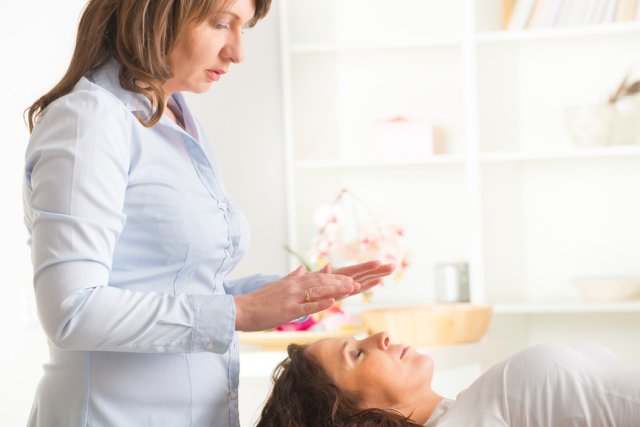
In some Reiki lineages, students are taught ‘the’ hand positions that they need to use, ‘the’ twelve hand positions, as if it were set in stone.

But do Reiki treatments really need to follow a set format, no matter what the energy needs of the client? Does every client have to be treated in exactly the same way?

I believe that having a set of hand positions to follow when you are starting out on your Reiki journey is very useful: you have some basic instructions to follow, you don’t need to worry, and you can concentrate on getting used to working with the energy, becoming comfortable with being with people in a treatment setting.

You are firing the energy from lots of different directions to make sure it has the best chance to get to where it needs to.

But this ‘one size fits all’ approach is a bit limiting. Not everyone is the same, so why would we apply the same hand positions to everybody we treat?

So how might we start to adjust or alter where we are resting our hands?

Varying your hand positions for each client

There are two ways to adjust the hand positions that you use: through scanning and through intuition.
Scanning is taught on most Reiki course and it is a way of finding out where the energy is flowing to on the client’s body in the greatest amounts. Energy flowing strongly gives people a variety of sensations, and common feelings might be heat in your hands, or warmth, fizzing, tingling, buzzing, throbbing, heaviness, a magnetic feeling etc.

You hover your hands a few inches away from the client, drift your hand from one place to another, or sweep from one area to another, and focus your attention on the sensations that you are getting on your hand/fingers.

When doing this, you may notice that there are areas of need that don’t tie in with the standard hand positions that you are taught, and you could add an extra hand position when you get that part of the body during your treatment, or alter the hand positions away from the standard ones, to accommodate this area of need.

Intuition is another approach that can be used to gear your treatment more towards the energy needs of the person that you are working on.

Intuition can express itself in a person in different ways: a general ‘impression’, a feeling of being ‘drawn’ to an area of the body, an ‘inner knowing’, or you may find that your hands are drifting apparently of their own accord to some area. This latter approach is something that we teach on our Reiki courses, in the form of “Reiji ho”, an intuitive approach that derives from Japanese Reiki.

So after starting off your treatment in whatever way you do that, you could then simply follow your impressions about where to rest your hands, and go with the flow.

Want to find out more about Intuitive working?

reiki book second degree manualsA big part of our Second Degree course involves helping people to work intuitively, so that the energy guides your hands to the right place to treat for each client.

In the Reiki Evolution 110-page Reiki Evolution Second Degree manual you can find step-by-step instructions to help you move beyond standard hand positions.

This manual isn’t just available to Reiki Evolution students: anyone can work with our manuals.

You can order a professionally-printed copy, or you can download your manual right now.

Here are the links that you need:

Reiki Second Degree manual

Reiki Second Degree eBook


Author:

Get out of the way!

In this short article I want to talk about the best way to approach working on other people, whether giving treatments or carrying out distant healing. I want to talk about our state of mind and our intent when channelling the energy.

The first thing I want to say is that we are just a channel for the energy, not the source of the energy. This seems an obvious thing to say, but we need to remember that we are not healers. We do not heal. We do not have that power. What we do when we treat someone is simply to create a ‘healing space’ that the recipient can use to move more into a state of balance. The recipient is responsible for their own healing, for what they experience or don’t experience; they are responsible for how they react to the treatment. They are healing themselves. We are just necessary bystanders in the process: we do not direct the energy and we do not determine the outcome.

So I am not so happy with the title “Reiki Healer” because it suggests that the Reiki practitioner has the power to heal; they do not. I don’t think that the title “Reiki Necessary Bystander” is going to catch on, so I prefer to use the title “Reiki Practitioner”. It describes what we do: we practise Reiki and it does not imply that we have the power to heal others.

This article is called “Get out of the way” because I believe that this is the best thing we can do when treating someone or when sending distant healing. We are not the source of the healing; we are not the source of the energy, so we do not need to be there, directing and controlling. We can stand aside and if we do so then the energy can flow strongly and clearly, without interference from us.

When we treat someone we are not ‘cheerleading’ for a particular end result: we do not give Reiki to get rid of someone’s head ache, or back ache, or to resolve their Gall Bladder problem, though of course these things may result from channelling Reiki. End results are out of our hands and to focus strongly on a particular purpose for the treatment is not helpful. Reiki will not be controlled by us in terms of end results and attempts to control the energy in this way just puts up barriers that prevent the energy from doing what it needs to do. Rather like the well-meaning amateur who gets in the way and prevents the professional from doing their job properly, our attempts to focus the energy to produce a particular end result will hinder the process for the recipient.

So our intent when treating someone or sending distant healing is that the energy should do whatever is appropriate for the recipient. We are neutral, we are detached, and we do not focus on outcomes. Ideally we should drift into a gentle meditative state when treating or sending distant healing, and this can be best achieved by our ‘disappearing’ into the energy, feeling ourselves merging with or becoming one with the energy. We merge with the energy and we merge with the recipient; we are empty. We do by not doing.

Though some people are taught that it is ok to talk and chat to people, or bystanders, when giving a Reiki treatment, to do such a thing is neither professional nor does it lead to effective treatments. If we are distracted then the energy flows less strongly, so if we want to do the best for our clients then we need to keep quiet, and encourage the client to keep quiet too. You can try an experiment for yourself if you like, to prove to yourself that distraction lessens the strength of your Reiki. You could try this at a Reiki share, for example. Start by resting your hands on someone’s shoulders and allow the energy to flow for a while. Then deliberately start up a conversation with someone sitting near you: take your attention away from the recipient and fully engage in the conversation. Do this for a few minutes. Then bring your attention back to the recipient, be still and quiet, and allow the energy to flow. How has the recipient’s experience of the energy varied?

Now, we do not need to be in a perfect meditative state in order to be an effective channel for Reiki, but it certainly helps to cultivate a still and empty mind. We are all human and it is perfectly normal for unwanted thoughts to appear in our head. But we should pay them no attention. If we pay the unwanted thoughts attention and try to get rid of them we then have two lots of thoughts: the thoughts we did not want and all the new thoughts about the need to get rid of the first lot of thoughts. We have made things worse!

The best approach to unwanted thoughts, then, is to allow them to drift by like clouds: pay them no attention, do not engage with them. They will leave. Some more may come, but pay them no attention either. In time you should find that your busy mind starts to quieten and some of your treatments will become beautiful meditations, with your mind emptying with the energy, and staying empty. Some treatments will not be like this, of course, but we do not need to be perfect. We can cultivate a more meditative state over time, moving in the right direction, and without worrying too much about individual occasions when our untamed brain kept on talking to us. This is a work-in-progress!

So Reiki is simple: you empty your head, you merge with the energy, do you not direct, you do not control, you do not try; you empty yourself and merge with the recipient, standing aside to allow the energy do what it needs to do, without interference from us.

Reiki Distant healing, Oneness and Usui’s system

oneness reiki distant healing

Distant healing in Usui’s time

Distant healing is an essential part of Reiki in the West. People on Second Degree courses are taught the ‘distant healing’ symbol and they learn how to ‘send’ Reiki to other people, in a way that transcends time and space.

But how was this done in Mikao Usui’s time?

Well, it seems that distant healing was not practised by Usui Sensei’s students, not in the way that we understand it, though they would have realised that such a thing was possible. And although we in the West are taught a ‘distant healing symbol’, these Reiki symbols were only introduced towards the end of Usui’s life, for the benefit of the Imperial Officers who trained with him, and thus most of the people Usui trained were not give symbols to use.

Most of his students used either Buddhist-style meditations or chanted Shinto mantras called ‘kotodama’ to get to grips with certain energies and states, and the work that they were doing was all about their own spiritual development and self-healing; treating others was not focused on or emphasised in the original system for example, and neither was distant healing.

So if the original students weren’t given HSZSN (the ‘distant healing symbol’) to use, and if they didn’t practise distant healing, what did they do that ties in with the idea of distant healing?

Reiki and Oneness

It’s all about Oneness, and this is a Buddhist idea: the concept that what we experience as reality is actually illusion, the idea that we are individuals, separate and distinct from other people is illusion, and that the true reality is that of oneness.

In Usui Sensei’s original system, some Second Degree practitioners who had worked for up to 18 months with the energies of earth ki and heavenly ki were given the opportunity to meditate on and chant kotodama that elicited a state of oneness, one of the goals of the original system.

For me, practising distant healing is a good way to experience a state of oneness because in distant healing you are becoming one with the recipient, you merge with them and the energy and you lose that distinction between the sender and receiver, subject and object.

It’s interesting that when we ‘send’ distant healing we are not sending and the receiver isn’t receiving: the idea is that there is no us and there is no them, and that’s why it’s possible.

A lovely conundrum!

Over to you

When you practise distant healing, what do you notice about the state that you experience?

Do you find that you’re in a space where you seem to transcend time and space?

What is your experience of oneness?

Post a message below to let me know what it feels like for you.

Want to find out more about Distant Healing?

reiki book second degree manualsA whole collection of distant healing methods are contained in the 110-page Reiki Evolution Second Degree manual. This isn’t just available to Reiki Evolution students: anyone can work with our manuals.

You can order a professionally-printed copy, or you can download your manual right now.

Here are the links that you need:

Reiki Second Degree manual

Reiki Second Degree eBook


Author:
Picture Credit: Alice Popkorn


Reiki Sensations

In this article I would like to talk about the sort of things that students might feel – or not feel – when receiving attunements or empowerments, when working with energy and when treating or being treated, and the significance of these sensations. The article is particular addressed to people who have just taken a First Degree course or who are only just starting on their journey with Reiki, though it should be of interest to people at all Reiki levels.

Attunements or empowerments

(Please note that, to avoid unnecessary repetition, I am going to use the word ‘empowerment’ to refer both to Reiju empowerments and Western-style Reiki attunements.)

When we arrive on a Reiki First Degree course, we probably have very little idea of what we might experience when going through an empowerment. If you read books about Reiki, everyone seems to be going through an exceptional, once-in-a-lifetime experience, but for most people it really isn’t like that.

There is no way of predicting what an individual will experience when receiving an empowerment, whether in person or at a distance. You may have an amazing experience, or you may feel very little or nothing. It is not uncommon for people to see some colours or feel some heat or tingling or pulsing or pressure in various areas of their bodies. For some people an empowerment is a unique experience, profound, emotional, an experience that is almost unbelievable. For others very little happens.

Sometimes you might find that there will be four people, say, on a course. Three people are talking about the surprising, or interesting, or special experiences that they just had, and one poor soul is sitting there thinking to themselves “I knew this wouldn’t work for me… I know Reiki is supposed to work for everyone, but it hasn’t worked for me”. We assume that if we notice a lot happening then the empowerment has ‘taken’, that it has worked really well, and we assume that if we felt very little – or if we felt nothing – then the connection ritual has not worked, that we haven’t been attuned, or we haven’t been attuned properly.

But what a student experiences when they receive an empowerment is no guide as to the effectiveness of that empowerment. In fact what a student experiences really is irrelevant, because empowerments always work. Of course it is nice and reassuring to have the “bells and whistles and fireworks” – it helps you to believe that something definite has happened – but someone who has noticed all these things has not been more effectively empowered when compared with a student who felt very little or nothing.

Experiences are interesting, but not important. They don’t mean anything in terms of whether, or how well, an empowerment has worked, because empowerments always work, no matter what the student feels or doesn’t feel.

Experiencing energy

People are all different, and people differ in terms of how sensitive they are to the flow of energy in the early stages of their work with Reiki. Sometimes people arrive on a Reiki course massively sensitive to the energy, and perhaps better able to sense subtle differences than is their teacher, and that’s nice for them, while other people may notice something very subtle, or perhaps nothing at all. Most people will feel something.

So when playing with energy, most people will feel something in between their hands when they try to make an energy ball. Most people will feel something when they try to feel someone else’s energy field, or if they practise ‘scanning’ (assuming that there is something there to detect – there won’t always be). But not everyone will feel these things to begin with, and the people who do not feel anything should not be disheartened: because sensitivity to such things can develop with practice and repetition. Most people will find that, no matter how sensitive they find themselves when they first learn Reiki, when they start to work with the energy regularly – for example by carrying out Hatsurei ho every day, and by self-treating – their sensitivity to the energy will increase. But this is a work-in-progress and we may need to be patient. And we may find that our sensitivity to the energy never reaches our goal, or is never as great as other Reiki people that we come across. Maybe we are setting an unreasonable target for ourselves.

And we should remember that sensitivity to the flow of energy is not the be-all and end-all of Reiki. We can work on ourselves and derive the many benefits that come through Reiki, no matter what we feel or don’t feel when we carry out hatsurei ho or self-treat. We can treat other people effectively no matter what we might feel or not feel in our hands. I have come across several successful and effective Reiki Master / Teachers who do not feel anything going on in their hands, and never have done. The reason why they continued their Reiki training, rather than giving up in the face of no physical sensations to encourage them, was because they practised on lots of people and they could see, by the positive responses they received from the recipients, that something was definitely going on, that they were doing good things, that Reiki was certainly doing something for the people they treated even though they couldn’t feel the energy.

You may ask how you can treat someone when you can’t feel anything, or if you can’t scan very well at the moment. Well, most people in the world of Reiki are taught a standard set of hand positions to use when they treat, and these standard positions can be followed, giving general coverage over the body; the energy is drawn to areas of need, so that works perfectly well. Not everyone scans. Not everyone is taught how to scan. It isn’t a vital step in a treatment, but it can be a useful one to perform if you can do it.

But if you can work intuitively then of course you can place your hands in the right places for each person you work on, and stay in each position for the most appropriate amount of time, not based on the sensations you are feeling in your hands but based on your intuitive impressions. Everyone can work intuitively with some practice, and you may well be taught how to carry out “Reiji ho” (a Japanese method for opening to your intuition during a treatment) on a Second Degree course. So an intuitive approach to treatments actually eliminates any advantage in being able to sense strongly in your hands.

Sensations experienced by people you treat

Now, you will not be surprised to know that the experiences of people being treated also varies a great deal. For some people, on some occasions, treatments are very strong. They might feel intense heat from the practitioner’s hands, see coloured lights, drift in and out of consciousness. And on other occasions that same person might feel the treatment to be mild and gentle. The energy is drawn by the recipient in amounts that are appropriate for them on that occasion, so the perceived ‘strength’ of any treatment is determined by the recipient’s need. The practitioner is just a necessary bystander in the treatment process.

While some people seem to quite often notice a lot happening when they are treated, there are also people who feel very little or nothing when they receive a Reiki treatment, no matter who they receive the treatment from. If you have just started out on your Reiki journey and you just happen to treat one of these people, or a few of these people, as your first ‘clients’ then you may end up disheartened, thinking that their lack of a strong sensation means that you are ineffective as a practitioner. We want the recipient to feel a lot because that reassures us that we are doing things ‘correctly’, that we are effective as a channel for the energy. But things aren’t always so simple: while quite often there may be general correlation between what the practitioner feels and what the recipient feels (a very hot area for the practitioner is felt as a very tingly area, say, for the recipient) this correlation will not always be there and, sometimes, you might find a practitioner feeling a raging furnace in their hands, amazed at the strength of what is going on, while the recipient did not notice anything at all, and perhaps didn’t notice anything at all during the entire treatment!

Summary

So really this whole article boils down to one simple phrase: “just for today, do not worry”. While it is perfectly natural to want to have some physical sensations to help us believe that we are really doing something when we use Reiki on ourselves and on other people, and while most people who learn Reiki will receive sufficient feedback to reassure them, this will not always happen. With practice and experience we start to let go of the need to be reassured by what we and others feel, and we come to realise that no matter what we feel or don’t feel, Reiki is working for us. But it can be difficult to accept this in the early stages, particularly if we are a little sceptical.

If you aren’t feeling too much at the moment my advice to you is to follow the instructions you were given: carry out your Hatsurei ho every day, self-treat regularly, and get your hands on as many people as you can. Do short blasts on someone’s knee or shoulder, treat people in a straight-backed chair for 20-30 minutes, do full treatments; go with the time you have you have available. The important thing is to get the hands-on practice and you will find, if you treat a good cross-section of people, that you will receive from them the positive feedback that you need, and with sufficient practice you may find that you start to notice more with time.

So be patient, don’t worry, and have fun with your Reiki.

Sending Reiki to the future

sending reiki distant healing to the future

Using distant healing creatively

I suppose that most people who send practise healing will send the energy to a friend or a family member, but the energy can be used more creatively too and, since Reiki doesn’t seem greatly constrained by either time or space, some people will send Reiki to their future.

So how might this be done?

Well, imagine that you have a public speaking engagement or a job interview, or a musical performance or an exam, any event where you could do with a bit of Reiki contentment sparkling over you. What you do is to imagine yourself in that future event, in whatever way feels comfortable, and imagine that Reiki is flooding into that event or situation, flooding into the room maybe, surrounding and engulfing you and any other people who might be there.

The Reiki that you are sending gives you just what you need on that occasion, supporting, nourishing and healing in the way that you need it, working its magic on the relationship between the people that are going to be there perhaps.

Reiki your day

Some people send Reiki ‘to their day’ by imagining their day ahead (in a brief, truncated or speeded up fashion) and flooding their day with Reiki, imagining everything going well, smoothly, calmly.

I have heard of someone who sends Reiki to ‘their bed’ each day, with the intention that the Reiki hangs around, ready to deposit itself on that person when they get into bed.

You can be endlessly creative with this!

Over to you

If this idea is new to you, why not experiment and see what’s possible, and let us hear about your experience by posting a message below.

Want to find out more about Distant Healing?

reiki book second degree manualsA whole collection of distant healing methods are contained in the 110-page Reiki Evolution Second Degree manual. This isn’t just available to Reiki Evolution students: anyone can work with our manuals.

You can order a professionally-printed copy, or you can download your manual right now.

Here are the links that you need:

Reiki Second Degree manual

Reiki Second Degree eBook


Author:
Picture Credit: renatodantasc

Attunements, empowerments & contact lenses!

Wait! Reiki can mess these up, apparently!
In this article I would like to talk a bit about attunements and empowerments used in Reiki, explaining the similarities and differences between these rituals. I was prompted to write this article after reading a message posted to an Internet discussion group a while ago, on the subject of Reiju empowerments. The message contained such a lot of misinformation and distortions that one could have concluded that it was posted mischievously, or maliciously, for ‘political’ reasons. Just the other day I smiled broadly because I came across an item on a web page which was trying to argue that the empowerments used by Mikao Usui were ineffective in connecting people to Reiki! Very strange. In any case, hopefully I can clear up some confusion or misunderstandings that people might have about attunements and empowerments, and this article should be of interest to people at all Reiki levels.

As for the contact lenses, you can find out about them towards the end of this article!

Introduction

No matter what sort of Reiki course you choose to follow, wherever you are in the world, you are likely to go through a ritual or a series of rituals which can be seen as a way of ‘connecting’ you to Reiki, a way of hooking you up to something that you were previously not connected to. That is a common way that such rituals are viewed: a way of ‘attuning’ you to something that you were not attuned to before, a way of plugging you into a new source of energy that was not available to you before.

But perhaps it is more useful to say that an empowerment, or an attunement, is a ‘ritual permission’, a permission to recognise something that is within, something that has always been there. The effect of the connection ritual is to allow you to channel energy for your own benefit, and for other people’s benefit, in a way that was not possible for you before you went through the ritual with your Reiki teacher.

Most people in the world of Reiki have been ‘connected’ using an “attunement” ritual, a version of the ritual that Mrs Takata was using, and while increasing numbers are now being connected using an “empowerment”, for the foreseeable future those attuned will always outnumber those empowered: most Reiki teachers attune, only a minority empower.

What are “attunements”

Until approximately 1999, everyone within the world of Reiki will have been ‘attuned’ using some sort of variation of the connection ritual that Hawayo Takata taught to the Masters that she initiated in the 1970s. Since the ‘70s Reiki has spread throughout the world and the attunement rituals used have evolved and changed as they have been passed from one teacher to another down the line. Some attunements are now quite complicated affairs, with many, many stages, while others are fairly simple, though there are some common themes that seem to run through most methods, for example the placing of the Reiki symbols into different parts of the student’s body (head and hands for example), tapping, blowing, affirming, visualising.

So there is not one standard attunement ritual used in the world of Reiki: there are endless variations, some quite contradictory to each other; if one method works in terms of the ‘theory’ behind it then a very different method does not make ‘sense’ and simply cannot work, and yet all methods do seem to work perfectly well. Some people insist that there have to be four attunements for Reiki First Degree, which is a big historical misunderstanding that I will not go into now, while others use three, or two, or even one attunement on their courses. All these approaches work.

It should be stated that Mikao Usui did not give people attunements, he did not attune anyone to any symbols, and he did not teach attunements. Attunements were not part of the system that Usui taught: he used empowerments instead. Usui taught empowerments to his Master students, and this was not done early on in their Master training – passing on the Reiki ability to others was only taught towards the end of the Master student’s formal training with Usui Sensei.

Now, the Imperial Officers who trained with Usui had not trained with him for long enough to have reached the level where they would have been taught to empower others, so where did the attunements used on most Reiki courses come from? Interestingly, it seems that after Usui’s untimely death the Imperial Officers put together a ritual that replicated the feelings or the experiences that they had when being empowered by Usui. Dr Hayashi passed on such a ritual to Mrs Takata, and then variations of this ritual spread throughout the world.

So attunements started their life as a constructed ritual put together by the Imperial Officers, and this ritual has now evolved, changed, altered over time as it has been passed from teacher to teacher in the West. These various attunement methods have been used to attune most of the Reiki people in the world.

So attunements work, of course. They ‘connect’ the student to Reiki. But that is not the end of the story: if we are going to get the most out of our Reiki then we are going to have to commit ourselves to working with the energy regularly, on ourselves, on other people, to develop our ability as a channel, to develop our sensitivity to the energy and to develop our intuition. An attunement gives us a baseline connection to the energy, but we can develop ourselves further, and benefit further, through our own efforts.

And in fact we can benefit from receiving further attunements, too. This is something that Reiki Master William Rand has been advocating for many years now, I believe. He does not say this because attunements are in some way ineffective, or temporary, or weak: he recommends that people get together to re-attune each other because he has found that there are definite benefits associated with having your ‘connection’ to the energy reinforced or renewed.

So one attunement is enough (or two, or three, or four, or however many attunements you had on your Reiki course, or however many attunements you believe are necessary), but there are definite benefits associated with being reattuned, and if we are serious about our Reiki then we need to also commit ourselves to working with the energy regularly. You don’t just go on a course and that’s the end of it: you need to work at your Reiki.

What are empowerments

When people talk about empowerments, they are referring to “Reiju empowerments”. You can write the word “Reiju” in two different ways using Japanese kanji, one way meaning “accepting the spirituality” and the other meaning “giving the spirituality”; spirituality in this case means ‘connection’ to the Reiki energy. In fact the word Reiju has been interpreted in several ways, for example “giving of the five blessings” and “the union of mind and ki”. The line in the Reiki precepts where it says “the secret method of inviting happiness through many blessings” might actually mean “the secret method of inviting happiness through receiving many Reiju empowerments”.

The empowerments that Mikao Usui used with his students can be referred to as “Reiju” and these were equivalent to a Tendai Buddhist blessing, a blessing that a Tendai teacher would bestow on a student with the intention that the student should receive what they need. Usui Sensei gave the blessing using intent only, but within Tendai Buddhism there is also a physical ritual that can be carried out which conveys the Reiju blessing; details of this ritual were passed to the West from Usui’s surviving students in the late 1990s and it is this ritual that we use on our “Reiki Evolution” First and Second Degree courses.

The effects of empowerments do not wear out. Empowerments ‘connect’ you to the energy; they allow you to recognise something that is already there. Just like attunements. The consensus that I have seen amongst those teachers who are using Reiju in practice, all over the world, is that not only are empowerments effective but they also confer special benefits. In my experience, students who receive Reiju seem ‘better connected’, better able to work intuitively, more sensitive to the energy in the early stages, when compared with people who have been attuned. Not everyone will agree with this, but many people who have moved from giving attunements to giving empowerments are saying the same sort of thing.

One empowerment is enough but it is nice do a few on a Reiki course, and we choose to carry out three empowerments on our First and Second Degree courses. But there are definite benefits associated with receiving Reiju repeatedly, and Usui Sensei’s students received Reiju from him again and again throughout their training at all levels. William Rand’s recommendation that Masters re-attune each other, because of the benefits associated, serves to echo this original practice. We echo Usui’s approach ourselves, by making distant empowerments available for all our students to tune into at any time on a Monday, every week, and Reiju empowerments are also given to students attending our teachers’ Reiki shares.

Receiving Reiju regularly helps to ‘reinforce’ your connection to the source. It enhances self-healing, it helps the student to develop spiritually, it enhances intuition and increases sensitivity to the flow of energy. Being reattuned will also help to achieve this, though as far as I can see it is not so common within the world of Reiki for re-attunements to be offered.

Now for the nonsense

One or two people are trying to argue that Usui Sensei’s method for connecting people to Reiki is ineffective. They are saying that Reiju is a weak and provides you with only a partial and lowly connection to the energy, that you are actually “dis-empowered”, unable to benefit from Reiki properly and unable to treat other people effectively.

These people – who will not have experienced Reiju for themselves, of course, or used Reiju in practice – are also arguing that Reiju-connected students are obliged to desperately carry out energy exercises every day to try and maintain some sort of a decent energy-channelling ability, and that they are dependent on their teacher for a regular ‘top’ up, without which their Reiki ability will dwindle and disappear. This is such a distortion of reality! By way of contrast, they also say that attunements give a far better permanent connection to the source, and the implication is that the student then does not need to carry out any energy work to develop themselves because they are perfectly connected right from the start, and no further commitment or responsibility for personal development is required.

Interestingly, in the same article, I was amused to hear that:

    You should not treat people with pacemakers. This is nonsense, of course. Please see my article “Restrictions on Reiki” for a longer discussion of this Reiki fable.
    First Degree does not really give you anything, and you cannot treat yourself and other people effectively at this level. This of course flies in the face of the cumulative experience of hundreds of thousands of people who have taken First Degree and whose lives have changed for the better through Reiki, and who have helped friends and family members at First Degree.
    You should take Reiki First and Second Degree in one weekend to be able to use Reiki effectively. Again nonsense, and the global consensus is that you should wait between Reiki levels to give yourself a chance to work on yourself and gain confidence, putting what you have learned into practice before moving on. Exhorting people to take Reiki1 and Reiki2 in one go, because they will not be able to do Reiki properly otherwise, is largely a marketing ploy in my view.

There is a lot of nonsense spoken about Reiki, and two more examples that were just sent to me the other day nearly had me choke on my cup of Tick Tock tea: there is a local college somewhere in the UK (I won’t name it) that tells it’s Reiki students that they should not treat people who wear contact lenses because the energy will distort the lenses, and in that same part of the country there is also a teacher who is telling their students that every time they use one of the Reiki symbols they are shortening their life by several minutes.

We have a word in England for such advice, and for the nonsense that is being written by one or two people about Reiju empowerments: “claptrap”. Claptrap should be avoided at all costs; claptrap will seriously diminish your enjoyment and experience of this wonderful system that we have been given. So the next time you hear that you shouldn’t treat people with pacemakers, or contact lenses, or green trousers for that matter, or the next time you hear that Usui’s method of connecting people to the energy doesn’t work properly, take such comments with a pinch of salt, ignore them, and move on!

A Reiki Diary

Peter Handy has kindly agreed to share his Reiki story, including publishing a “Reiki Diary” that he kept during the first four weeks after learning Reiki. Here is what Peter has to say…

“Four years ago I took a Reiki course provided by my local carers association. I had been a full time at home carer for my wife for 14 years. She had suffered several strokes over the years, the first one 30 years previously, shortly after we were married. My daughter who was 22 at the time I did the course, was also suffering health problems and as she lived alone and over 10 miles away I was doing a lot of travelling between our homes. In short it was all getting to me, I developed depression, and the Reiki course was part of my reigime to combat the depression and get off the tablets. I did my level one Reiki and since then have used it for self healing, and for my wife and pets. Reiki helped me to come off medication and helps my wife to bear the pain that is largely resistant to strong pain killers including morphine.

We, (the students on the course) were encouraged to keep a Reiki diary for the first 4 weeks after attunement, and I recently came accross mine, the rest of this story is copied from that diary more or less verbatim, exept where clarification needed a few extra words. When refering to muscle spasms/-pains, Reiki was not used as a stand alone treatment. Pain killers and muscle relaxants were used as well. Any effects My Wife Linda reported were over and above what she would have expected from medication alone. On occasions the Reiki does not appreciably lessen the pain ,which can be exteme at times, but she always said it helps her to cope better with it. It certainly gives me a lift knowing I can actualy do something practical to help her.

Wed 12th December 2007
Attended the Quaker Meeting house in Newcastle-u-Lyme for Reiki first degree seminar, Teacher – Nicola Brough.

Following the attunement – First attempt with fellow student, she felt more effect on her heart and abdoment areas which I did ‘hands off’ than on the head/neck area which I did hands on. When she practiced on me I did a silly thing, I tried to see what would happen if I resisted or tried to channel energy while she was treating me. What happened then wasn’t static electricity because she had been ‘hands on’ for a minute or so, but she immediately recoiled and said she had got a shock from my forehead (I wont try that again!)

Thurs 13th
am. Short treatment on my wife , top of head, then front/octipical. She lay in bed with severe head/neckpain. After treatment pain was less. She described front/occtipical position as partly closing a curtain on the pain. Pain receeded from eye and neck but overall headache remained. pm. self-heal.

Fri 14th
Treated my daughter . she’d had a headache for 2 days. Used head and shoulder positions. She reported cold sensation radiating down through her head. Headache was not cured but she felt more energised and her mood lifted. pm. self-heal.

Sat 15th
Ready to go out for Xmas lunch with her family, Linda felt ill and had headache. We had a little time, so I stood behind her as she sat in her wheelchair and we did Reiki. Afterwards, she said the experience was ‘something else’. Her abdomen chakra opened immediately and was ‘buzzing’. I felt the energy was building very slowly with little or no sensation in my hands.I concentrated harder and was aware of an increase in energy flow. At this point Lindas pain rose breifly followed by a sudden release of emotion and a reduction in her pain levels. It was if a blockage had been cleared. She coped well with the day, and she was on good form, which she would not have been had the bad head persisted. pm. self-heal.

Sun 16th
Saw Jo my daughter to fetch and deliver her new sofa. her headache had improved after Fridays treatment, but had since returned. She had migraine symptoms. Light headed, speech a bit muddled, left sided headache. I did longer treatment today, her sitting on a chair, hands off, over crown of head, then front to back left side of head, then sides of head, then neck/shoulders. As I moved down to her chest/back, still with hands about 6″ from the body, she suddenly reacted to a sensation of heat to her solar plexus.She opened her eyes to see my hand over that area. She said it felt weird* but wanted to continue. I told her to leave her eyes open if she wanted to, so there would be no suprises. I repeated the crown of head, hands on. She was clearly affected by the teatment and felt faint, so I left as she went to bed. She phoned 2 hours later to say how pleased she was that her migraine had stopped.

I had started with a headache and had been sweating and coughing on the drive home, and felt I was starting with a cold. I later self-treated my head, throat, and sinus area and the cough ceased.
Tonight I self-healed and tried to let go of many negative thoughts and emotions.Some are long standing and will need ongoing effort. My heart chakra is difficult to open and causes some discomfort. I have been working on my base and feet and seem to be making a little progress.

Mon 17th
self-treatment.

Tuesday 18th
Treated Linda as she lay in bed with bad head and muscle spasms. She then slept after feeling the tension release from her neck.
self-treatment.

Wed 19th
am, self-treat. Gave Linda Reiki to head and shoulders in the few minutes before she went out shopping with her sister. I had cold hands but she felt heat, she felt calmer and her breathing steadied. She saw ultramarine or cerulian? blue colours as the tension released. pm. self-healed.

Thurs 20th Dec
Tried static self-healing**, No hand positions used, just sat and recieved the energy.

Fri 21st
Linda got sudden rt side head/eye/neck pain. Drugs didn’t seem to be helping. Reiki ‘narrowed’ the pain enough for her to be able to get to bed.

She said the head and neck treatments were very powerful and she felt stronger and more able to stand the pain. Once we were upstairs I treated again both of us sitting on the bed. She made a gutteral sound as her throat chakra opened and she/we became emotional. She lay down feeling more relaxed.

Sat and sunday 22, 23rd
self treated,

Mon 24th
Self healing, then treated jack our old dog, who is suffering a bit. he was quite frisky afterwards, (could be because he hasn’t had much fussing lately)

Tuesday 25th
I treated Linda as she lay sleeping (we had agreed this would be OK to do previously). Hands on hip and shoulder area.
(Next day she said she had had a nice dream, lying in a meadow, sun shining, tall buttercups, and as she lay dozing in the sun her heart chakra opened up.) Self-healed.

Wed 26th
am. Treated Linda as she lay in bed, hands on head, then hips and shoulders. She felt those areas shimmering for some time afterwards.
pm, Linda developed a migraine, I treated her sitting on the bed, and she saw a complete rainbow or color wheel (hard to describe). She started to giggle as I worked over the midriff area. Then she was treated laying down and she had a strong throat reaction, and saw a vivd flash as i was doing hands off work to the soles of her feet. later on did self healing.

Thurs 27th
am early, did short self-healing before getting out of bed.

Fri 28th
am, did self healing sitting downstairs, after taking Lindas breakfast up. Linda told me she has had very bad eye/head/neck pain since 4am, so after self-healing I treat her as she id lying in bed, sitting alongside in a chair.

1st) hands on hip and shoulder, we got immediate response which stopped the pain!
2nd ) hands on, sacral and top of neck.
3rd) side of neck at base of octipical, fingers touching only.
4th) forehead-base of skull, hands on.
5th) One hand on crown.
6th) Each foot in turn.

Linda said it was the best treatment yet, the first to completely eliminate the pain. She felt shimmery for some time afterwards. I checked in on her about 10-15 minutes later and I felt engergy coming from her as I walked around the bed, like radiation from a crystal but bigger.By bedtime she was ‘going off’ again as she was tired, but it was 10.30. note: it is a rare occurence for Linda to be pain free.

Sat 29th
am, self-healing. treated Linda as she was lying in bed with a bad head. The pain diminished to the point where she was able to get up and go out for a drive and a walk around a local beauty spot (I walk Linda uses electric wheelchair) but the headache didn’t completely clear up like yesterday.

Sun 30th Dec
Linda poorly, to the point where she was agitated/emotional. Headache, itching skin, and legs rigid with spasm. treated at 10.50am. Her neck muscles relaxed, but arm/leg spasm persisted and her headache was still there. I treated her again in the evening with more success, and I tried to cocoon her her with energy at the end of the Reiki treatment, bearing in mind her need for emotional comfort and support. I didn’t tell her what I was attempting as she rested with eyes closed, and it was just an instinctive thing on my part. I drew the shape of a cocoon around her in the air with my hands, I and tried to fill it with loving energy. The next day without any promting she said she had felt protected by a bubble or aura, and that she felt she could have touched it if she had tried. I can’t remember reading or hearing of anyone doing this cocooning, but it seemed to work. self-healing before bed.

Mon 31st
I started with a migraine in the afternoon, the first for a few weeks. I didn’t take tablets but tried self healing with reiki. The typical visual distrurbances continued, but it didn’t develop into the usual throbbing head/nausia session. further self-healing before bedtime.

Tues 1st Jan
Did self-healing at night time, then treated Linda as she lay in bed tired and with a headache. She relaxed and slept well, and only got up twice in the night to go to the toilet instead of the normal 4-5 times.

Wed 2nd
pm.Treated Linda as she lay in bed, ner neck pain subsided, and I again tried to cocoon her, and she said it worked again.

Thursday 3rd
Self healed am, before going to take Jo shopping.

Fri 4th
self heal after lunch, then treated Linda, her lying in bed, back towards me as I sat on a stool at side of bed. Rt hand on crown and left on hip, then below the base, hand off. Pain in rt eye increased before reducing. Spine, sacral-back, then sacral-neck. Both hands over then on shoulders/neck area. Feet, right first then left. Cocoon. Her eye/head pain went in the first couple of minutes of hands on the crown of head and other hand below the base chakra. From that point on she gradualy went into a deeper state of relexation, and finaly felt cocooned. She sais the cocoon was strong and felt it would have moved with her if she had moved. She slept, and felt well enough to get up after a couple of hours.

Sat 5th
Self healed. Linda in bed with ususal head/eye/neck pains. Hands on head and shouldersrelaxed the the neck but eye pain persisited. Worked on back and tummy area as she had been having constipation pain since yesterday. Then as I worked on her left foot her eye pain went away. She felt the energy rising up from her foot and through her body and when it reached her head the pain stopped. 20 minutes after treatment she opened her bowels.

Sun 6th
self treated.

Monday
2.45am Linda awake with bad head, gave short hands-off to her neck as I lay falling asleep and it helped her to relax and get back to sleep.
Later on I went to Nicola at Burslem for Reiki treatment, I was tired beforehand, I was still very tired but relaxed afterwards and had an early night!

Tues 8th
Noon, Reiki on Linda, for head pain and muscle spasm. She felt a hand on her heart chakra long after I had removed it ,and she touched the area a couple of times to check (she lay with eyes closed). She relaxed and her eye pain ceased. I worked on her feet for 15 minutes and she felt the energy rise upwards through her body. I then did self-healing. I concentrated on the area that Nicola had been working on yesterday, as I could feel something happening in my rt side sacral area but I concentrated more on the central spine area. (I have had back problems for many years).

Afterwards I felt as if I was standing differently, either taller or straighter or both, and my balance felt a little weird. I also felt more awake, not so tired and with an elevated mood.

Wed 9th Jan
Self healed, finished after midnight, I must start earlier.

**On 20th dec I was just sitting, reading the level one manual and as I read about the hand positions and the chakras I was feeling a physical effect. For example as i read about the chakras my chest area started reacting. I decided to go through the self healing routine but just sit and imagine. The effect was just as if I was placing my hands in the positions. I imagined my hands on the front of my face covering my eyes, and i felt energy on that area. When I went on to the next position I still felt the energy in the previous one. As I progressed from one imagined hand position to the next I quicky ran through all the previous ones. In this way i eventualy felt as though I had several pair of hands working on me at the same time. I have tried this since and it works quicker If I briefly put my hand on the place , and it sort of jump starts the proccess.

My wife has remarked on a similar effect, sometimes feeling as though I still had a hand on a part of the body I had moved away from.

*My daughter found the unexpected charge of energy a little disturbing. Even though Reiki seemed to help, and I offered to perform Reiki any time she wanted, she has never asked, and I haven’t offered since. It seems to me that ‘hands off’ generally speaking gives more of a sudden surge of energy while ‘hands on’ builds up slowly. Being an ex-mechanic I liken this to a slow discharge of electricity, compared to the ‘spark’ you get when electricity jumps over an air gap in a spark plug.

Using a family member as my ‘client’ has been invaluable. At the start, I asked Linda to give me honest feedback about what she felt and what effects if any ,the Reiki delivered. In any case she is a disarmingly honest person, and in her own words ‘she never bullshits’.

From previous experiences, (she once did an aromatherapy course, and she had regularly visited a spirit healer some years before), I knew she was very sensitive to subtle energy. She would buy crystals and say” just hold that it’s really buzzing” but I would seldom feel anything. She can’t stay in one of those large crystal shops with the huge geodes for more than a few minutes, as it jangles her nerves. The first time the healer put a crystal under the couch Linda knew straight away that something was under her. My Reiki of late has been a little seldom, but re reading the diary has reminded me how much it has helped and I will return to using it more often in the future.

Thank you for reading my story.

Peter Handy

Sending Reiki to the past


reiki distant healing the past

Getting creative with Reiki distant healing

I suppose that most people who send practise healing will send the energy to a friend or a family member, but the energy can be used more creatively too and, since Reiki doesn’t seem greatly constrained by either time or space, some people will send Reiki to ‘heal their past’.

They would do that by imagining a past situation or event which has had some ongoing effect on them in terms of what they believe about themselves, some event that has held them back in some way, preventing them from being the person they could be, and imagine that the energy is cradling or flooding that event, doing whatever needs to be done to bring healing and resolution.

Whether the energy actually flies back in time to flood that event with Reiki is a moot point I think, but since all we have to experience is the present in any case – we live in the now – what this practice does is to heal the ongoing effects that the earlier event has had on the way that we feel about ourselves and other people, for example; it calms the ‘ripples’ that the event has produced over the years, to remove the chains that are holding us back in some way.

Healing the ‘inner child’

Some people might send distant healing to themselves in the past, imagining themselves as a child, by way of healing the ‘inner child’, not imagining a particular event or situation, but a representation or composite of them in childhood.

And, interestingly, this seems almost to be a Reiki version of ‘Time Line’ work, which is a practice in NLP: clients are taken back to find early events that have had a deleterious effect on their self-esteem, for example, and insights are passed on to the younger them that have knock-on effects in terms of how that earlier situation has affected them.

Over to you

If this idea is new to you, why not experiment and see what’s possible, and let us hear about your experience by posting a message below.

Want to find out more about Distant Healing?

reiki book second degree manualsA whole collection of distant healing methods are contained in the 110-page Reiki Evolution Second Degree manual. This isn’t just available to Reiki Evolution students: anyone can work with our manuals.

You can order a professionally-printed copy, or you can download your manual right now.

Here are the links that you need:

Reiki Second Degree manual

Reiki Second Degree eBook


Author:
Picture Credit: thejbird


The 10 Rules of Reiki


In this article I thought I would set down ten things that you can do – ten principles to take account of – to benefit your practice of Reiki. This is not something that has come from Japan, or from early practitioners of Reiki: it is just something that I have put together myself. I hope that this article will be of interest to people at all Reiki levels.

(1) Reiki is all about you

Although Reiki is sometimes presented in the West as a sort of complementary therapy, a hands-on treatment technique, or a form of Japanese spiritual healing, that is not what Reiki is all about. If your practice of Reiki consists mainly of treating other people then you are missing the point because Reiki is all about you! Reiki is a personal practice for your self-healing and your spiritual and self-development. You are the priority here.

In Usui’s time the treatment of others was not focused upon or emphasised, in fact treatments were a bit of a distraction from the main thrust of his teachings, which Usui Sensei referred to as a “system to achieve personal perfection”. Right from the start, the system was about personal development, not working on others.

So to gain the greatest benefits for yourself through Reiki, you need to establish a decent routine of working on yourself in whatever way that you were taught. If you were taught Western-style then do your hands-on self-treatment regularly, if you know about Japanese-style Reiki then practise your Hatsurei ho; if you know about Usui Sensei’s original system then add his self-treatment meditation to your regular Hatsurei.

I know that some people seem to have the view that working on yourself is in some way ‘selfish’, but if you cannot look after yourself properly then how can you help other people? By working on yourself regularly you make yourself a better channel and more effective at what you do in terms of treatments, so there are plus points all round for those who make themselves their Reiki priority.

(2) Base your practice on the precepts

Usui Sensei established a simple spiritual system that was rooted in his precepts, his ‘rules to live by’. Rather than being an interesting set of instructions to read on a course and put to one side, Usui’s precepts are at the very heart of his system, and it was said that as much spiritual development could come through following the precepts as would come through doing any of the energy work. If we are consider ourselves as ‘practising Reiki’ then we will follow the precepts.

So we need to think deeply about the precepts and how they affect our lives. We need to consider each precept in turn and reflect on how that precept might impinge upon and guide our thoughts and behaviour and relationships and priorities. And we need to do this regularly, using the precepts as an ongoing source of guidance, the effects of which will make a real difference to us, and the people around us, over time.

The precepts are something that you we drip-feed into our lives, something that we refer to regularly and reflect on regularly, for our own benefit and for the benefit of the people with whom we come into contact.

(3) Practise mindfulness

Although not referred to on most Reiki courses, the practise of mindfulness was as important part of Usui Sensei’s system as were the precepts, and in fact mindfulness is hidden in the precepts! Mindfulness is a form of meditation that one can perform at any time, when carrying out ordinary, mundane activities like walking somewhere or washing dishes or sipping tea, and involves becoming consciously and fully aware of your thoughts and actions in the present moment, non-judgmentally, existing in the moment.

When you are living ‘in the moment’, fully engaged in what you are doing, fully aware of the present moment, then you are existing in a state where there is no anger and there is no worry. By not dwelling on the past or speculating about the future, by embracing fully the present moment, you are living the precepts, and mindfulness brings with it humility, honesty, compassion and forgiveness.

So mindfulness is a way of experiencing Mikao Usui’s spiritual principles.

(4) Work on yourself daily

Reiki isn’t something that you can pick up once in a while, play around with for a bit, and then drop again… not if you are looking to receive the many benefits that are available from the system, anyway. If you are looking for consistent benefits then you need a consistent practice. The precepts say “just for today”, and that is a good starting point: just do something with Reiki today. You can manage that. It doesn’t have to be hours and hour’s worth. Just do something for 10 minutes: you have ten minutes. Do something for 20 minutes. And if you don’t have ten minutes, get up 10 minutes earlier: problem solved.

Don’t worry about what you will do tomorrow: just focus on today.

When tomorrow comes, do the same. Just do something with Reiki, even for ten minutes. Don’t worry about tomorrow: just do something today.

(5) Commitment is the key

There are spectacular benefits to be enjoyed through practising Reiki, and all you need to do is to work with the energy consistently, focus on the precepts and practise mindfulness. The benefits build up cumulatively, you see, and sporadic and occasional practice isn’t enough if you want the very best out of your Reiki. You will get out of the system what you are prepared to put into it, so Reiki deserves a little of your time each day. You need to plug away at a few simple things, a few simple exercises or routines, and make them a regular part of your day, as regular a part of your routine as brushing your teeth or your hair.

And once you have established a regular habit of working on yourself with Reiki then you will find that it is difficult to stop: you will find that you really miss your hatsurei session or your self-treatment if you miss a day. That is the sort of position you are looking to get yourself into and by committing yourself to working with Reiki each day, even if it is a little inconvenient, you will reach that point.

(6) Don’t try too hard

While we do need to commit ourselves and establish a decent routine of working on ourselves in order to obtain the many benefits that are available to us through Reiki, we should at the same time make sure that we do not try too hard, work for too long, or take our practice too seriously. Reiki is best enjoyed in a gentle, laid-back and light-hearted fashion rather than in a fists-clenched, furrowed-brow, tense, ‘ready for a lot of hard work’ sort of way. We do not force Reiki and we do not force a fierce practice on ourselves.

Reiki is rather like a flowing stream of water, and we are a rough rock sitting in that stream. The rock will become smooth, of course, but this will be achieved gently, through having the water flow consistently, and this will be done in its own time.

We might read about some of the experiences that other Reiki people might have when working on themselves, or receiving attunements/empowerments, or treating others (seeing colours, feeling particular things) and we may not notice all these things ourselves; we may notice very little. We may then think that if only we tried a bit harder then we would notice these things and then we would then be ‘doing it properly’.

But trying hard and trying to force things is the best way there is to put a great big block on your progress. You will progress fastest when you give up trying and just be. Stand aside (metaphorically), do the exercises, treat people, and don’t think or worry about what you do or do not experience. Be a bystander, be neutral and empty, have no expectations. That is the best approach, the approach that will lead you to progress at the right speed for you.

(7) You don’t need to be perfect

Along with the need to be relaxed and laid-back and light-hearted about your practice, you should also make sure that you are not beating yourself up for not being perfect! You do not have to be perfect in order to obtain benefits for yourself through Reiki, or to treat other people successfully. No-one else is perfect, so you don’t have to be either.

So perhaps your mind wanders when you do a treatment or work on yourself. So what? This happens to everybody else. Don’t worry about it (there is something in the precepts about worrying). It you make a big thing about it and try through ‘force of will’ to have an empty mind, you have just made things worse: now you have two lots of thoughts… the first thoughts and then all the new thoughts about getting rid of the first lot of thoughts! Don’t worry. Pay the thoughts no attention. Let them go. Bring your attention gently back to what you were doing. Feel the energy flowing through you; imagine yourself merging with the person on the treatment table. Over time your mind will settle, and you’ll spend more of your time in a nice empty meditative state, but thoughts may well intrude again, and some days will probably be better than others. That’s ok. You’re human. It will sort itself out with time.

(8) Don’t keep trying to puzzle out ‘why’

To get the best out of your Reiki I recommend that you don’t spend too much time trying to puzzle out why you are – or are not – experiencing a particular thing. Don’t keep trying to work out what a particular colour that you or the recipient saw during a treatment means, or ponder the significance of a colour that you saw when self-treating. Don’t keep wondering what a particular sensation in your hand means or why you felt a lot of energy flowing into a particular area of someone’s body, or why you didn’t feel any energy flowing into a particular place. It doesn’t matter.

Your head can really mess up your experience of Reiki if you keep on frantically thinking about, analysing and questioning things. Don’t think! Just be. Empty your mind, merge with the energy, if you are treating someone then merge with the recipient, and let it happen. Follow the flow of energy when you are treating, yes, and allow your hands to stay for longer in areas where more energy is coming through, but don’t start frantically trying to puzzle out what is going on: Reiki works on lots of levels and you won’t know what’s happening so you may as well give up thinking about it and let go: enjoy the process, enjoy your treatments and give up the mental effort! It makes it so much easier that way!

(9) Trust your intuition

Along with not questioning everything that you feel or don’t feel, you should also not keep on doubting the things that you are feeling and noticing. If you feel something, you feel it: you are not making it up. You cannot make yourself feel something.

So if you notice that energy is flowing into you more strongly in a particular area when you are self-treating, accept that and go with it, self-treating for longer there than in other positions. The same applies when treating someone else: if you feel that there is a ‘hot spot’ or ‘fizzy area’ then accept the sensations and treat for longer there. You are not making it up.

Neither are you making it up if you feel strangely drawn to a particular area of the body. You are intuitive and you can work intuitively straight away. All you need to do is to stop second-guessing and doubting yourself, be still, and simply accept what comes to you. It doesn’t need to make sense. Don’t try and puzzle it out: just accept it and treat in the way that feels appropriate.

(10) Ignore silly rules and restrictions

While we are making sure that we are not cluttering our practice with endless thoughts, questions and doubts, we should also thrown out as unnecessary the various rules, regulations and restrictions that we may have been taught. Reiki does not need to be controlled, blunted and restricted by man-made rules that have no basis. Reiki is safe and Reiki is simple, and simple approaches are usually the most effective.

So we do not have to slavishly follow a prescribed set of hand positions when treating ourselves or other people and we do not need to say a set form of words for our Reiki to work. We do not need to follow ritualised sets of hand and body movements in a particular sequence to be able to treat someone and we do not need to refrain from treating people with various medical conditions. Reiki is safe and Reiki is adaptable. It allows many different ways of working that are all valid. There is no ‘one’ way that Reiki has to be used, and we should ignore admonitions that we should ‘always’, or ‘never’, do a particular thing.

So, to get the most out of your Reiki, I recommend that you make a commitment to yourself to work on yourself each day as your top priority, but not beating yourself up if you miss the occasional day. Use Hatsurei ho and self-treat, focus on the precepts and drip-feed mindfulness into more and more of your daily activities. Don’t try too hard though: be light-hearted and forgiving towards yourself because you don’t have to be perfect. Try not to clutter your mind with lots of thoughts and doubts and questions: just be neutral, have no expectations, be empty and content. And make sure you keep it simple.

My Reiki Story – Gail Vettraino

This is another in our series of “My Reiki Story” posts that we will be adding to the Reiki Evolution blog, where a Reiki person talks about their journey with Reiki. In today’s “My Reiki Story” we hear from Gail Vettraino from Lanarkshire…

The popularity of Reiki in recent years has resulted in Reiki being regarded as an holistic energy therapy. Whilst there is some merit in this essentially Western interpretation of Reiki, to experience the true wonder of Reiki, it is best understood from the Japanese perspective. I experienced Reiki from the Japanese perspective through Reiki Evolution a website owned by Taggart King. Taggart is a Reiki Master based in Spalding, Lincolnshire. He teaches Reiki on live courses and unusually online with distance learning courses.

At the time I enrolled for First Degree Reiki online with Taggart, I was emotionally, spiritually and physically wrecked from helping my young sons come to terms with the death of their father. I had been drawn to Reiki for about ten years and always felt amazing after a treatment, energised, positive and even strong enough to deal with an abusive husband. After I had left my husband and he died, I really struggled financially and couldn’tafford regular Reiki treatments, but I knew Reiki was the only therapy that would heal me completely. With the stress of widowhood my health had deteriorated and I had a virtually constant tremor in my leg, my balance and co – ordination worsened and I was using a walking stick. So much for your thirties being the time of your life !

I decided the way forward was to train in Reiki and self heal. But the killer question was, ‘Where do I find the right Reiki Master ?’ Finding the right Reiki Master is like finding the right partner – a game of needles and haystacks ! Having little money and no transport (Reiki Masters seem to delight in deeply spiritual, isolated and generally inaccessible habitats, which is bad news for single mothers !) the idea of doing my training online was a genius concept. Until of course my inner cynic came out to play. I am highly adept at being a technophobe and the idea of regularly emailing Taggart to receive guidance and receiving my empowerments (the ritual tuning into Reiki) long distance irritated my logical nature. But as ever, my intuitive side won and I trained online. The distant empowerments literally knocked me off balance ! The immense feeling of raw energy descending onto your aura is very hard to explain. Initially it felt overwhelming, yet before I realised it, I quickly adapted to the feel of the energy. I can’t imagine life without Reiki coursing through my system. Let’s just say I’m more mindful with my cynicism these days !

I rapidly began to heal on every level and passed my First and Second Degree Reiki quite quickly. It’s two years since I needed my walking stick, the tremor has ceased and my balance, co – ordination and energy levels have improved massively. According to my neurologist, I had a congenital balance disorder that was progressive, incurable and not treatable with medication. In his opinion, drugs would exacerbate my symptoms. So much for expert medical knowledge ! I have returned to work and bought a house, things that simply weren’t possible three years ago. I am currently scheming a way of finding the money to train as a Reiki Master – hopefully my bank manager doesn’t read this !

Well OK, I hear you say. You felt lousy, did Reiki, got better. What’s the significance of Japanese Reiki ? The answer’s very simple – it’s the real deal. Taggart has studied extensively Mikao Usui’s teachings and has replicated them as authentically as possible. By paring down Reiki to it’s simplistic Japanese origins, Taggart reveals the immense power of this therapy. Unlike the Western interpretation of Reiki that sees it as a transference of energy with added angels, crystals and possible leprechauns (it could happen !) to give it ‘va – va voom’, Japanese Reiki connects the person with divine. Although Reiki has its roots in Tendai Buddhism and Shintoism, it remains spiritually neutral. Consequently, a person experiences profound peace from whichever deity makes sense to them. The connection with the divine provides access to the unconditional magnanimous love of the Universe and both body and soul are equally attended to. According to Taggart, Mikao Usui never used the term Reiki – that came later. The use of hands on healing and the significance of symbols was evolved for military medics to use a triage system to treat patients with serious injuries, until appropriate treatment could be given. It was from the military doctors that the term Reiki evolved. Instead Usui described his teaching as a ‘Method to Achieve Personal perfection’. The Precepts of Reiki were instituted by Usui and essentially revolve around the significance of being at peace with yourself and others, being constructive with your life and not being anxious.

The teachings of Mikao Usui were a synthesis of ancient cultural traditions and a reflection of the impact of modernity on Japan in the late nineteenth century. Usui did not use a uniform teaching stratagem, instead he tailored his teaching to the student’s needs. Taggart has replicated this approach by combining ancient wisdom with the convenience of computers. So Reiki, the spiritual linkage between the human and the divine, has become universally accessible through the internet. Hopefully, reading this encourages you to experience the unlimited healing of the Universe through Reiki. Obstacles such as lack of time or transport are no longer relevant, thanks to Taggart’s online training. May your Reiki journey, whether it is in the flesh or in cyberspace be as rich and as rewarding as my journey.

With thanks to Taggart King for his permission to write about Reiki Evolution.

Gail Vettraino


If you would like to tell your Reiki story on the Reiki Evolution blog then send a jpeg head/shoulders photo of you, your name, and let us know about your story: when and why did you learn Reiki, what happened on your course, how do you use Reiki and how has Reiki changed things for you? Send your contribution to taggart@reiki-evolution.co.uk.

And if you like the sound of what Reiki can do for you, or if you’d like to take your Reiki further, remember that we have Reiki courses running throughout the UK, as well as multimedia home study courses.

Live UK Reiki training courses
Home study courses

Scanning at a distance

reiki scanning teddy bear

Using props

In “How to send Reiki distant healing (Part IV)” I spoke about different ‘props’ that you can use when sending distant healing: sending Reiki into a teddy bear, or a pillow, or even into your upper leg.

All these props serve to represent the recipient’s body, helping you to focus your attention on the recipient and direct the energy into a particular part of their body at a distance. You are bolstering your intent by using the prop to make your intention ‘concrete’.

But in the same way that you are using the intermediate of the teddy bear, say, to help ‘transmit’ the energy, you can also receive information from the recipient about where the energy wants to go in greatest amounts, and we can do this by ‘scanning’ the teddy bear (or pillow).

Scanning a prop

Scanning, when used on a client on a treatment table in front of you, is a method where you hover your hand(s) over their body, a few inches away, and drift your hands from one place to another, paying attention to the sensations of heat, pulsing, fizzing, tingling, heaviness etc in your hands, by way of finding those areas that are drawing most energy, so that you can spend longer treating those areas.

Your hands can then guide you in terms of how long you treat in a particular area since you will notice that, after a while, the flow of energy subsides and you can then move on to another hand position.

And we can scan the teddy bear or pillow, who represents the recipient, and we can hover our hands, drifting our hand from one place to another, noticing the flow of energy through our hand into the prop, into the recipient.

An area of great need in the recipient will show itself by a more intense flow of energy into a particular part of the prop.

Just like in a live Reiki treatment, when you find an area on the prop that is drawing a lot of energy then you can treat that area for longer, until the flow of energy subsides.

So the distant connection to the recipient works two ways: as a way of directing Reiki to them, and also as a way of receiving information about where the energy needs to go.

Over to you

If you haven’t experimented with this sort of thing before, why not have a go and let us know what happened by posting a message below.

Want to find out more about Distant Healing?

reiki book second degree manualsA whole collection of distant healing methods are contained in the 110-page Reiki Evolution Second Degree manual. This isn’t just available to Reiki Evolution students: anyone can work with our manuals.

You can order a professionally-printed copy, or you can download your manual right now.

Here are the links that you need:

Reiki Second Degree manual

Reiki Second Degree eBook


Author:
Picture Credit: Horia Varlan