The Kaizen of Reiki

If you have come across the word ‘kaizen’ before it will probably have been in the context of industrial quality control or personal development. “Kaizen” is a Japanese word that is usually translated as ‘improvement’, but it means more than that. The word has connotations of continuous, gradual, orderly and never-ending improvement, the willingness to constantly, relentlessly pursue improvement a small step at a time. The application of the kaizen principle is the reason why Japan’s economy was transformed after the Second World War. All workers were encouraged to make suggestions as to how quality and production could be improved, even by tiny, tiny percentages, but over time the effect of these tiny percentage improvements, applied consistently and built upon, transformed Japanese industry.

So what has this to do with Reiki? Well the word kaizen actually appears towards the end of the Reiki precepts. The line in Japanese is “Shin shin kaizen, Usui Reiki Ryoho”, which could be loosely translated as “Mind body change it for better Usui Reiki method”. So when Usui was talking about using his system to improve the body and mind, I get the impression that we are looking at a lifelong commitment to work with the system, to focus the energy on ourselves again and again, long-term, in order to produce small incremental improvements within ourselves, to dedicate ourselves to developing our effectiveness as a channel. But small changes build on previous small changes, an enhancement upon an enhancement leads to amazing development over time. And Usui’s original system gives us the solid, concrete techniques that we can use to develop ourselves: as channels, in terms of spirituality and in terms of intuition, to produce our own individual Reiki Evolution!

So how do we pursue our own kaizen of Reiki? How do we apply the concept of continuous and never-ending improvement to our practice of Reiki? Here are a few suggestions…

Root your practice of Reiki in daily energy work.

If you are serious about wanting to obtain the many benefits that are available to you through the Reiki system then you are going to have to work on yourself most days, ideally every day, and by doing so you will build up the beneficial effects of Reiki within you. It is not sufficient to use Reiki on yourself once a week, or to assume that if you treat other people occasionally then this is enough to give you the Reiki you need.

Your first priority should be yourself, and this means daily energy work. This does not need to be an onerous task, nor does it need to take a long time to carry out. Sometimes we decline to use Reiki on ourselves because we do not have the perfect opportunity, perhaps because we do not have, say, 30 minutes to work on ourselves. Yet even 10 minutes of energy work, when carried out consistently each day, would be far better and produce much better results than doing nothing for days, and then a great big blitz for a big chunk of time on a weekend to try and ‘catch up’. Spending even a small chunk of time working on ourselves each day builds up a momentum and stirs changes which build and build. Sporadic practice leads to some beneficial changes, but you are not maximising your Reiki potential.

So, how can we work on ourselves? Well, a good place to start would be to practise Hatsurei ho, a series of energy exercises taught in the Usui Reiki Ryoho Gakkai (the ‘Gakkai), an association set up after Usui’s death by the Imperial Officers who had trained with him for a while. ‘Hatsurei ho’ means something like ‘start up Reiki technique’ and consists of a series of energy meditations/ visualisations that focus on your Tanden (Dantien in Chinese) and which are designed to be carried out every day. The effects of Hatsurei ho are to:

    Clear and cleanse your energy system
    Help to move your energy system more into a state of balance
    Help to ground you
    Help to build up your personal energy reserves
    Allows you to grow spiritually
    Develop your ability as a channel for Reiki
    Help to develop your sensitivity to the flow of energy
    Help to develop your intuitive side

The exercises take perhaps 12-15 minutes to carry out each day, and can be fitted into the busiest of schedules if the will is there. We can all make this time for our Reiki practice.

But we should also focus the energy more specifically on ourselves, on our own self-healing, by carrying out a self-treatment each day. Whether you carry out the Western ‘hands-on’ method of treating yourself, or use the self-treatment meditation that Usui Sensei taught, you should focus the energy on yourself on a regular basis to help bring things into balance for you on all levels, and to help you to release things that no longer serve you: mental states, emotions, physical things. The energy will deal with many aspects of your body/mind, many deeply-embedded imbalances, if we give the energy the opportunity to do its work on us, digging deep and chipping away at the ‘baggage’ that we carry, over time.

We prefer to use Usui Sensei’s self-treatment meditation because it seems more intense and versatile, but all self-treatment approaches are valid. Usui’s Sensei’s system was all about spiritual development and self-healing, so Hatsurei Ho and self-treatment can lie at the very heart of your Reiki practice. You need to put yourself first, and the principle of kaizen means that by working on yourself consistently, great transformations are possible. You owe it to yourself to allow yourself to obtain the benefits that are available to you through Reiki.

Receive spiritual empowerments throughout your training and beyond.

Training with Usui was rather like martial arts training, where you were in ongoing contact with your teacher over an extended period of time. Part of your training involved receiving simple spiritual empowerments from Usui Sensei, repeatedly, at all levels. Each empowerment reinforced your connection to the source, cleared your channel for the energy, allowed you to develop spiritually and enhanced your intuitive potential. To echo this practice, Taggart sends out a distant Reiju empowerment every week, on a Monday, which can be ‘tuned in to’ by any Reiki person. You can find out about this, and what to do, by visiting this page of the Reiki Evolution web site:

Reiju Broadcast

On each occasion that you receive Reiju you are given what you need, and as your needs change from one occasion to another, this simple spiritual ‘blessing’ helps you to develop. A one-off attunement or empowerment does of course give you something permanent, and when you learn Reiki for the first time the attunements or empowerments that you receive provide you with the ability to use Reiki permanently, but it does not stop there: by receiving empowerments on a regular basis you are building momentum and allowing the energy to penetrate more deeply within you.

If we are committed to ongoing improvements within ourselves then we should make the time to receive an empowerment weekly. And again it is the regular commitment which is the key, the key to deepening your experience of the energy and its beneficial effects on you.

Work on developing your intuitive potential.

Mikao Usui’s original system did not focus very much on the treatment of others, and any instruction on treatments would not have involved slavishly following a set of ‘standard’ hand positions that you had to apply to everyone you treated. Usui’s method was simpler and more elegant. You allowed the energy to guide your hands to the right place to treat, different from one person to another, and different within the same person from one treatment to another. The way we have been taught to do this is through a ‘technique’ called ‘Reiji Ho’ (indication of the spirit technique’), a way of emptying your mind and merging with the energy, getting your head out of the way to allow intuition to bubble to the surface. The exciting thing about Reiji Ho is that it works for everyone, and with time – we come back to kaizen’s small incremental improvements – your hands will move more quickly, more consistently, more effortlessly, and you will start to attract more intuitive information. So every time we treat someone we should spend time cultivating our ‘Reiji’ state of mind, and gradually, gradually, we develop.

Learn to become the energies.

…that you are introduced to at Second Degree and Master levels. Usui’s system didn’t involve symbols as far as most of his students were concerned. Students were expected to carry out meditations over an extended period of time in order to learn to experience different energies and, at Second Degree, students were introduced to the energies of “earth ki” and “heavenly ki”, which represent two fundamental aspects of our being. By practising ‘becoming’ earth ki and heavenly ki again and again – a powerful self-healing practice – these energies became so familiar to the students that they could ‘connect’ to the energy direct without having to use a prop like a symbol. Usui provided some Shinto mantras for some of his students to use to invoke the energies, but it was possible to move beyond these mantras with time, too. In my article ‘A Simple Way with Symbols’ I describe a meditation that you can use to ‘become’ these energies.

But again we see that to obtain the greatest benefit, to enhance self-healing, to free up our practice and move beyond symbols, takes time and commitment. A quick meditation carried out a few times is not enough: Usui Sensei’s students spent 6-9 months meditating on just one energy, and this was done because the principle of kaizen – plugging away and developing by small amounts again and again – led to deep changes over time.

Live your life according to Usui’s guiding principles.

Usui’s simple principles to live by offer perhaps the best example of the principle of kaizen in our Reiki practice: Usui Sensei’s precepts are a work in progress. They are not something that you read through and think “OK, got that”: the precepts are simple to read and understand but they are something that you drip-feed into your daily life over time, more and more over time.

We may begin by thinking about the precepts when we first come across them on a First Degree course: we reflect on how they might impinge on our lives, our thoughts and emotions, our behaviour; we might imagine situations from that past that might have proceeded better had we exemplified the precepts, and we might imagine situations in the future and see ourselves behaving in a way that demonstrates that we are living the precepts.

But this initial surge of interest in the precepts is not sufficient to produce the beneficial changes that the precepts can produce in our lives.

To fully embrace Usui Sensei’s spiritual principles takes regular reflection and ongoing thought. On an ongoing basis we consider our thoughts and our behaviour, we reflect on the principles and what they mean to us. If we do this then over time we will find that living the precepts becomes easier, that our behaviour is modifying itself, that there are more permanent changes in the way that we react and behave and relate to other people. But this will only happen if we ‘chip away’ at our current behaviour patterns, using the precepts as our guiding light. There are no quick fixes: the precepts are not just for First Degree. The precepts are the essence of our Reiki practice.

Now, we do not need to be perfect, we do not need to beat ourselves up for not applying each and every principle on all occasions, but by dedicating ourselves, and by forgiving ourselves, and by trying to do a little better each day than we did the day before, we transform ourselves.

That is the key to our kaizen of Reiki: dedication and commitment, patience and forgiveness, and openness to the source. Long term.

Were you taught the correct ‘Power’ Symbol: Variations on CKR

reiki symbol ckr choku rei

Reiki started simply

Reiki is very simple, you know.

You start working with energy at First Degree and at Second Degree you’re introduced to three symbols that you can use.

These symbols were taught to the Imperial Officers and a few others by Usui Sensei, and Dr Hayashi passed them on to Mrs Takata, who taught them in the West.

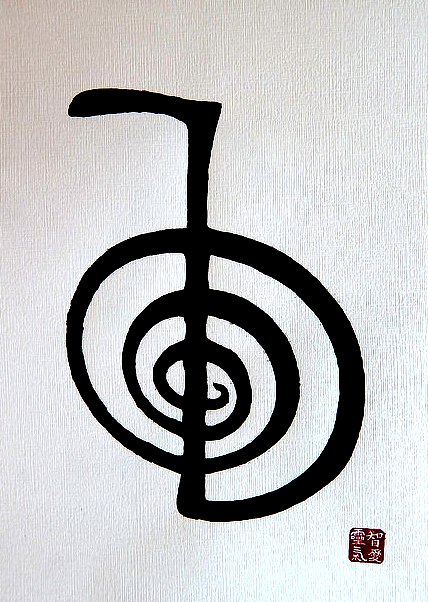
One of those symbols was CKR, perfect and complete on itself – see above.

So we started messing about with it, which is fine – experimentation is a good thing – but some of the experiments have become ossified in different lineages and passed on as ‘the’ way to do Reiki, rather than being taught as interesting variations.

Let’s have a look at some CKR variations

CKR with a spiral going the wrong way

There was only ever one CKR and it had an anticlockwise spiral.

If you’ve been taught one CKR and it has a clockwise spiral then you’ve been taught something that is quite different from what Usui intended.

Different shapes can be used to represent different aspects of the energy, and they will all frame the energy in a particular way, and if you want to frame the energy in the way that Usui intended then you do need to use the symbol that he taught.

Use two mirror-image CKRs, not one

There was only ever one CKR and it had an anticlockwise spiral, so if you want to use an additional symbol that is a mirror image of the original then that’s your choice, but please realise that this is not what Usui was teaching and most Reiki people don’t do this.

Certainly don’t feel that you ‘have’ to use these two symbols for Reiki to work properly because that simply isn’t the case.

Use CKR to put energy in and reverse CKR to take energy out

CKR is an image that you can use to represent or elicit earth ki, one of the two basic energies or aspects of our existence: earth ki and heavenly ki.

The person who you are working on will draw that energy to where they need it to go, and in the right amounts for them on that occasion. If you’re stepping in to decide for yourself that they need more energy or less energy, you aren’t really allowing the energy to do what it needs to do, unless you are doing this intuitively, in which case you’re working in partnership with the energy, and it is guiding you.

Usui Sensei didn’t teach two CKRs, one of them to take out energy; there was a reason for that: Reiki will do what people need to have done, and if energy needs to be released then plain Reiki will help a person with that without you having to use a specific symbol to achieve it.

If you are currently using a reverse-CKR to ‘take out energy’, you might try dispensing with that for a while and see what happens.

So if you want to use the variations on CKR then that’s your choice, but please know that while this is a way that you can work with Reiki, it is not the only way, other Reiki people work in a different way from you, and these variations were not part of the system that Usui taught.

Over to you

If you were taught some of these non-standard versions of CKR as “the” way that you should practise Reiki, may I suggest that you experiment:

  • Use the CKR that you can see on this page, meditate on its energy to get to grips with how it feels, how it affects you
  • Draw it over your palm to experience its energy
  • Use it in practice when you treat someone, flooding yourself and your client with its energy

How is what you’re doing different in quality or nature from what you were doing before?

Did you like this blog?

If so, you are going to love this book…


Liberate Your Reiki!

“Whether you are at Level 1, 2 or Reiki Master Teacher Level (regardless of the Reiki flavour you are trained in), this book is very much for you! Within hours of starting to read this book, it has rejuvenated and enriched my own practices with a wealth of information and useful examples too.

The more you read the more you’ll have those wonderful ‘aha’ moments. I know I am already benefiting personally from the knowledge I’ve gained, but so will all my family, friends and clients too. Thank you Taggart for creating this incredible, uniting, enlightening book.”

Heidi Gaffney-Evans

Liberate Your Reiki!

86 Articles About Reiki: One Inspiring Vision

In this Reiki book you will find 80+ articles about Reiki, written by Reiki Master Teacher Taggart King. You will discover how to set your Reiki free, free from the constraints, dogma, rules and regulations of Western-style Reiki courses. Get back to Reiki’s original Japanese method and embrace simplicity, flexibility, creativity and intuition.

This book is suitable for people at all Reiki levels: beginners, those who are developing their Reiki, and Reiki Masters/Master Teachers. You will find advice about self-treatment meditations, energy exercises to build your ability as a channel, you will discover how to work with your intuition and embrace the power of intent.

Explore different distant healing methods and discover the beauty of Reiki’s original Japanese form. Learn how to use creativity and visualisation to enhance your self-treatments and treatment of others, and ditch all the silly rules and regulations that stifle the practice of Western Reiki in many lineages.

Finally, read Taggart King’s “10 Rules of Reiki”, the essential principles for a powerful and fulfilling Reiki practice.

This professionally-printed Reiki manual has 370 A5 pages, a glossy soft cover and we will send it to anywhere in the world!

Read the contents list before you order, if you like, by clicking on this link: Table of contents

Book: 370 pages.

Price: £15.99 + p&p


Or Download a PDF version now for only £12.49


Author:
Picture credit: Nathaniel_U

Equine Reiki in pictures

I would like to share with you all some pictures of the lovely Pancho receiving Reiki from one of my students Brenda

At the start of the treatment, Brenda connects to Pancho with one hand on the wither and the other on the chest connecting through the heart.

Brenda moves on to let Reiki flow through the back and loins, as she does this Pancho closes his eyes and lowers his neck slightly


Pancho shows he is enjoying the treatment; chewing and licking his lips 


As Brenda moves on to send Reiki to the hind quarters, Pancho responds by lowering his head further, keeping his eyes closed as he softly goes to sleep. 
 
 
__________________________________________________________________
 
Below is a poem that Pancho inspired me to write after one of our Equine Reiki sessions…
 
To be seen
 
As I meet your gaze and you look into my eyes,
You look deep into my soul,
The feeling of another being seeing my inner self,
Connecting through as one.
No outer appearances are perceived,
Just purely loved,
To feel so special from ‘just’ a look,
You know who I am,
What I am,
Why I am.
You see the purpose and perfectness of the human soul,
You bring those qualities to the surface, just though being.
To be seen by you, is to truly see myself.
 
______________________________________________________
 
If you would like to read more about Equine or Animal Reiki, why not take a look at Sarah’s books ‘The Complete Guide to Animal Reiki’ and ‘The Handbook of Equine Reiki’. Both are available through this link https://reiki-evolution.co.uk/reiki-manuals.htm and through Amazon  http://www.amazon.co.uk/s/ref=ntt_athr_dp_sr_1?_encoding=UTF8&search-alias=books-uk&field-author=Sarah%20Berrisford
 
Visit Sarah’s website www.epona-equine-reiki.co.uk for more information regarding courses.

Feng shui your Reiki

Many of you will be familiar with Feng Shui, the Oriental art of placement, where you arrange your living environment to allow smooth flow of chi through your home, eliminating areas where chi will stagnate, and slowing down the speed of fast-rushing chi. So what has that to do with Reiki? Well they both deal with chi, but what I am really thinking of is applying the basic principles of Feng Shui to our practice of Reiki. This may seem a little strange, but please bear with me.

The basic principle of Feng Shui, the first thing you have to do before you do anything else, is to get rid of your clutter, because a cluttered environment leads to a cluttered life. Only once you have rid yourself of your unnecessary bits and pieces should you move in to apply the other more specific principles of placement. So could we de-clutter our practice of Reiki, what would that be like, and how could we achieve that? Is our Reiki cluttered now? How could we pare it down to the essentials and leave the unnecessary stuff behind?

We do seem to have a tendency in the West to make things endlessly complicated, almost on the basis that if it’s more complicated then it’s better. We like to introduce rules and regulations and restrictions and dogma, maybe because rules make us feel supported and safe, or maybe because we just can’t leave a simple thing alone! Yet the system that Usui Sensei taught to his surviving students wasn’t complicated. It wasn’t cluttered. It was simple and elegant and profound, and I think that we’ve drifted away from that in many ways. We’ve introduced rules and restrictions and dogma into many aspects of Reiki practice: connecting to the energy, treating someone, hand positions, distant healing methods, situations where you ‘should not treat’. This is all clutter and we can do without it. Freeing ourselves from this burden of technique and method and limitation would be a great and beneficial clear-out. We don’t need it. It holds us back. Let’s look at a few examples of unnecessary clutter.

A while ago I was contacted by a poor girl who had been taught that she needed to go through a fifteen-stage ritual in order to ‘connect’ to Reiki. She and the other students on the course were quite worried, obviously concerned that if they didn’t get all the stages right then the energy wouldn’t come through properly and their treatments would be ineffective. Naturally they wanted to do the very best they could for the people they were working on, and they were focusing hard on getting all the necessary stages right.

Yet ‘connection’ with Reiki is simply a state of mind; you connect when you intend to connect. Some people will hold their hands in a particular position (hands above them with palms uppermost to the sky, hands to the sides with palms face up, hands in the prayer position, hands in their lap with palms up, hands folded over the Dantien). Maybe they will say a set form of words, but all these are optional. Bring the energy through your crown to your Dantien and bathe in the light, flood the energy through your body, be still; you are connected when you intend to be. It is a matter of focus, a matter of where your attention lies.

Some people are taught that they must always keep one of their hands in contact with the recipient when they treat, based on the idea that if you take both hands off then you have lost your connection to the recipient and the energy will not flow properly. But your connection to the recipient is a state of mind too: you focus your attention on them, you merge with them and become one with them, and that is sufficient no matter what you are doing with your hands. In fact your treatment starts as soon as you are standing by the table with your attention directed towards the person. Your treatment has already started when you are scanning, or feeling the energy field. Reiki works just as well when you have your hands off the body, though Reiki is basically practised as a hands-on method.

Some Reiki people are taught rigid ‘standard’ hand positions that have to be used every time you treat, and there is the view that if you are not using ‘the’ hand positions then you haven’t been taught properly. Some even have a rigid time limit that has to be followed, so you can only keep your hands in each position for so many minutes… you can buy Reiki CDs which make a little ‘ping’ sound every three minutes (or whatever), and everyone changes hand positions like a robot. Yet what if your hands are going like crazy, what if there energy needs to flood into a particular area for a long time and you need to keep your hands there for 5 minutes or 10 minutes or 15 minutes? The answer would seem to be that you follow the system rigidly and ignore your hands. How sad.

Now standard hand positions are useful when you first learn Reiki: it’s reassuring to have some sort of system to follow. But we can move beyond those standard hand positions in a couple of ways. When we ‘scan’ the body we night discover areas that are drawing lots of Reiki, but they aren’t covered by the ‘standard’ hand positions… we can alter our hand positions accordingly, or add extra positions, to make sure we’re directing the energy into the areas that are drawing the most Reiki. We can use intuition, too, to control our hand positioning, and this has great benefits for the recipient because we are directing the energy into just the right combination of positions for each person we are working on. We might feel inexplicably ‘drawn’ to a particular area, we might just ‘know’ that we ought to be treating a particular area, or we might be practicing “Reiji Ho” from Japan, where our hands are drawn by ‘invisible magnets’ to the right areas to treat. Again we are leaving the rigid standard positions to one side and going with the flow. That was Usui’s way: there were no real standard positions. You simply put your hands where they wanted to go.

Distant healing is another area where lots of rules and regulations have crept in over time. Some people are taught quite complicated rituals that they have to carry out when they perform distant healing, with a set form of words that ‘have’ to be used in a particular way, and with various required visualisations. Yet the bare bones of distant healing are to know where the energy is to go – to set a firm intent – to use the distant healing symbol maybe, and to merge with the recipient, allowing the energy to flow. Anything beyond that is optional. People have different styles: some like to actively visualise and develop a detailed ritual, and that’s fine, but it’s not actually necessary. Others like to keep it simple, and that works just as well. Even the use of the distant healing symbol is optional, though it does help us to focus on merging with the recipient, a way of experiencing ‘oneness’ with the person you’re sending the energy to. Distant healing is perfectly possible at First Degree level, too: it’s simple a matter of intent, of focusing your attention in a particular way. The energy follows your thoughts, it follows your focus.

The final area where we could give our Reiki a big ‘clear out’ is in the rules and restrictions that can control who we should and should not treat. Some people are given a long list of ‘contraindications’: situations where you should not give Reiki because it might be dangerous. Some contraindications that I have come across include: pregnant women, babies, people with pacemakers, diabetics*, people undergoing an anaesthetic, people wearing contact lenses, people with cancer, people suffering from stress, people with broken bones, people taking homoeopathic remedies, people undergoing chemotherapy, people with a torn muscle. There will be many more examples taught in different lineages. These restrictions are nonsense, they have no basis: there is no proper evidence – even anecdotes – to back up the restrictions that are taught in some lineages. Reiki is safe, the person’s body draws it to the right areas to treat, and Reiki is seen as divinely inspired, intelligent, it is seen as pure unconditional love. That view hardly sits too well with the suggestion that you can hurt someone using Reiki. We think too much, we worry too much, and we create problems where there are none.

So a practice of Reiki that follows the first principle of Feng Shui will be a simple practice, free from rules, restrictions and self-imposed limitations. Feng Shui’d Reiki will be free from dogma, and free from rituals that you ‘must’ follow for Reiki to work effectively. It will be a practice that is based on simple intent and intuition, where you merge with the recipient, where you become one with them, and where you let the energy guide you. Let’s get rid of all that clutter and free up our practice, and just let the energy flow.

[ * There appears to be some anecdotal evidence that some diabetics may experience a short term alteration in blood sugar levels following a Reiki treatment. They should be made aware of this possibility and monitor their sugar levels accordingly. In theory a course of Reiki treatments could alter a diabetic’s blood sugar levels long-term, and thus their insulin requirements, and again they should be aware of this and monitor their blood sugar levels accordingly. However, this does not mean that you should not treat diabetics using Reiki, as is suggested in some quarters. It just means that diabetics should keep an eye on their blood sugar levels following a Reiki treatment or a course of Reiki treatments, which is what they should be doing routinely, anyway.]

Do I always have to use the symbols?

reiki symbols in treatments use

So many Reiki rules!

In most Reiki lineages the Reiki symbols are taught on the Second Degree course, though some are taught one symbol at First Degree I believe.

A lot of rules have built up about what you can and can’t do with symbols, what you always must do, and of course these rules end up being contradictory.

The only rule that applies to Reiki is ‘there are no rules’ I believe, and what I’d like to do here is just run through a few ‘symbol rules’ that you can choose to ignore.

Draw the symbols over your palm every day or you’ll “lose” them

Some poor Reiki people are frantically drawing the three symbols over their palms every morning because if they don’t they’ll “lose” the symbols and won’t be able to use them any more.

I have to say that this is nonsense, and is something that most Reiki people will not be doing.

The symbols are graphical representations of different aspects of the energy, they are triggers that you can use to access and energy, to direct an energy, and you don’t even need to be ‘attuned’ to a symbol for it to work for you (but that’s another story).

Please don’t draw the symbols over your palms every day for fear of losing them.

You always have to use the symbols when you treat

Why?

Why would you always have to use the symbols when you treat someone?

You are attuned to Reiki, you have been working happily with the energy since your First Degree course, channelling it for your benefit and for the benefit of others, and suddenly someone does some mystical hand-waving over you and you can’t use Reiki unless you keep drawing out symbols?

That makes no sense at all, particularly when you realise that there are a lot of Reiki practitioners and Masters who have moved away from, or beyond, the use of the symbols and just allow the energy to do what it needs to.

The symbols are useful tools, a way of focusing your attention on and experiencing different aspects of the energy, but they’re not compulsory!

Try only using a symbol during a treatment when the symbol seems to ‘want’ to be used, when you feel it’s right to use in a particular hand position, when it ‘calls’ to you.

Go with the flow and let the energy guide you, so you’re gearing the treatment more towards the needs of the person you’re working on.

See what happens.

Always draw every symbol over each hand position

Oh dear, this would be so ham-fisted, to have to frantically draw out three symbols in every hand position you use when treating someone.

If you were taught to do this, I would like to suggest that you experiment, try out different ways of working that don’t involve this very busy, cluttered approach, and come to your own conclusions about what’s necessary.

It’s not a very Japanese approach, is it?

If you think about traditional Japanese arts they do pare things to the bone, leaving only the bare, elegant essentials.

Clutter-free Reiki is a much calmer, and potent.

Over to you

If you have been taught some of the rules and restrictions I mentioned above, please do experiment for yourself and come to your own conclusions about what’s necessary and effective.

You don’t need to slavishly follow all the instructions that you were given by your teacher; you can find your own comfortable approach with the energy.

Post a message below to le tme know how yoru practice has changed over time.

Want to find out more about Reiki symbols & treatments?

reiki book second degree manualsA whole load of info and advice can be found in the 110-page Reiki Evolution Second Degree manual. This isn’t just available to Reiki Evolution students: anyone can work with our manuals.

You can order a professionally-printed copy, or you can download your manual right now.

Here are the links that you need:

Reiki Second Degree manual

Reiki Second Degree eBook


Author:
Picture Credit: Ashley Van Haeften


Podcast: Sound Healing

Mel Diamond

Hi,

I am very pleased to be able to share with you a talk given by Mel Diamond at the Reiki Evolution 2011 National Gathering.

Mel hosted a very popular workshop on sound healing at the Gathering, and Regent’s College must have resonated to its very foundations with what we ended up doing!

Podcast

Click here to download this podcast


Taggart KingThe 2012 National Gathering will be held on October 6th in central London, where there will be more interesting talks to listen to. You can book your place now by visiting this page: 2012 National Gathering. To qualify to attend, you need to have Taggart King in your Reiki lineage.

Mindfulness and compassion

In this article I want to talk about Mindfulness and Compassion, which I believe are two essential components of Reiki practice. Whether we are treating others, working on ourselves, empowering others or living our lives with Reiki, we should grow to embody those two states, the essence of the Reiki precepts.

Mindfulness

According to Usui Sensei’s surviving students, Mikao Usui introduced his students to the practice of mindfulness at First Degree level, and emphasised this more at Second Degree level. According to the Concise Oxford Dictionary (9th Edition), to be mindful is to take heed or care, to be conscious. Mindfulness or being mindful is being aware of your present moment. You are not judging, reflecting or thinking. You are simply observing the moment in which you find yourself, fully aware. Moments are like a breath. Each breath is replaced by the next breath. You are there with no other purpose than being awake and aware of that moment.

So mindfulness is a state of living in the moment, of being relaxed, calm and fully engaged in what we are doing. Mindfulness is being fully aware of what is happening right now and giving ourselves completely to our task without distraction. By learning how to enjoy and be in the present moment we can find peace within ourselves.

Like precepts, mindfulness is largely associated with Buddhism and it is a meditative practice that is not reserved for special meditation sessions: it is a practice that you can embrace as part of your daily life and when carrying out routine and mundane tasks.

The best guide that I have found to the use of mindfulness as part of your daily life is the following book, written by Thich Nhat Hanh: “The Miracle of Mindfulness” and I recommend that all Reiki practitioners and teachers obtain a copy and practise being mindful during their daily activities.

I believe that Mikao Usui’s precepts are all about mindfulness, and that when we are exhorted by the precepts to “just for today” release anger and worry, we are being guided to exist as far as we can in a mindful state. Anger and worry are distractions, you see, and if we can exist in the moment by being mindful then we will not dwell on the past and beat ourselves up for things that did not go the way we wanted, and we will not dwell on the future, perhaps worrying about things that have not yet happened. We can learn to release our attachments to the past and the future and just “be” now, content and accepting in the moment, by learning to be mindful.

Compassion

The final precept, that of being “compassionate towards ourselves and others” is for me an exhortation to be gentle with ourselves, to be patient, to be light-hearted, to not take ourselves quite so seriously and above all to be forgiving – first of all of ourselves but also of others. By accepting and forgiving ourselves we start to release our anger and our worry, and move towards a state of contentment in the moment.

The original system was a spiritual path, a path to enlightenment, and the precepts were what Usui Sensei’s system was all about. These principles are a foundation for everything we do with Reiki: the states of mindfulness and compassion arise from following the precepts and from working with Reiki.

For example, how do we feel when we carry out a Reiki treatment? Treating someone with Reiki is a special, special gift. We feel a closeness, an intimacy, a merging with the recipient; we receive trust and we experience compassion. Ideally we should just be there in the moment, with the energy, with the recipient, with no expectations. We do not treat someone with the intention to resolve their health problem or eliminate their headache. We just merge with the energy and allow Reiki to do its work; we create a sacred space for healing to occur. If our mind wanders, as it may do, then we notice this and gently but firmly bring our attention back to the present and what we are doing. We become one with the energy as it flows through us, we become one with the recipient, and we experience that blissful contentment in the moment. When we treat we are mindful: we are an observer, not a participant.

Though some are taught that you can hold a conversation with someone as you treat, or watch television at the same time, this really will not lead to the best being given to the recipient. To be the most effective channel we can be, we need to be there with the energy, fully and gently engaged in our work, giving ourselves fully to the task without distraction.

Those same principles apply when working on ourselves, whether carrying out Hatsurei ho or self-treating. The state we should seek to achieve is that of being fully engaged in the endeavour, of being with the energy without distraction, merged, aware and simply existing in the moment, with a gentle feeling of forgiveness, love and compassion towards ourselves.

So both Mindfulness and Compassion are fundamental to our life with Reiki, fundamental to the Reiki precepts, to working on others and working on ourselves. Not surprisingly they are also an essential component of the transmission of Reiki to another person through carrying out Reiju empowerments. Reiju is the ‘connection ritual’ that Usui Sensei used, and taught to his surviving students. It is simple, elegant and powerful, free from the clutter and detail that surrounds most Western attunement styles. When we perform Reiju we have no expectations: we are there in the moment with the energy, following the prescribed movements. We are relaxed and fully engaged in what we are doing, aware of what is happening right now, and we give ourselves completely to our task without distraction. That is the essence of Reiju, the essence of treatments, the essence of the precepts, and the essence of our life with Reiki.

Declutter your treatment rituals

declutter reiki treatment rituals

Time for a Reiki spring clean?

Reiki treatments are carried out in a lot of different ways and many rituals have been developed and passed on in different lineages.

Reiki has also been affected by the belief systems of people who are involved in other energy practices and it’s natural for Reiki teachings to become ‘coloured’ by a teacher’s personal quirks and idiosyncrasies too.

Trouble is, these practices end up turning into “this is the way that you have to do it” as they are passed on from teacher to student, teacher to new teacher, and that’s unfortunate since some people end up lumbered with quite complex rituals that they feel they have to carry out for a treatment to be done ‘properly’.

Reiki is greater than that.

Reiki works simply and intuitively and doesn’t need to be accompanied by a lot of dogma. There will be Reiki practitioners out there who treat their clients using a lot of rituals that other effective Reiki practitioners do not use, and there will be people out there using Reiki effectively while not carrying out stages and rituals that other practitioners regard as essential.

Let’s look at a few examples of ideas and practices that I regard as unnecessary.

If you were taught to do these things, why not experiment and find your own approach.

Keep at least one hand on the body at all times for fear of losing your connection

I have written about this one before, and if we can send Reiki from one side of the planet to the other just by thinking of someone, there will be no problem in ‘losing’ your connection to a client on a treatment table in front of you should your hands stray a few inches from their body.

‘Connection’ is a state of mind and comes through focusing your attention on the recipient. If you’re doing a Reiki treatment on someone then you are connected to them!

Treat from head to toe and then you must go back up the body from feet to head

Seems a bit clumsy to me, and is sometimes combined with the previous paragraph, so you end up with “always keep at least one hand on the body at all times and work from head to foot, and then back to the head again”.

The general approach within Reiki seems to be to work from head to feet, though working the other way might be the right thing to do sometimes.

My approach is to work intuitively so I don’t follow a set of rules that have to be applied to every client in the same way. Why should every client receive the same format of treatment? They have different problems, different energy needs.

‘One size fits all’ doesn’t fit very well with me.

Always throw out ‘negative’ energy at the end of treatment

If you believe that there is negative energy and if you believe that it will stay with the client (and presumably cause them problems) if you don’t throw it away, then I suppose you’d better throw it away.

And if you’ve got it on you before you throw it away then presumably you don’t want that stuff hanging around on you either, so you really need to throw it away.

But not everyone is taught that and not everyone does that, and some people believe that Reiki is a pure healing energy that is drawn by the recipient’s need, and gives the recipient what they need on that occasion, balancing and transforming in a way that is right for them.

And in that case, we wouldn’t need to think in terms of accumulating stuff that Reiki couldn’t get rid of, and dealing with it ourselves.

Always ‘ground’ the energy at the end of a treatment by putting your hands on the floor

Some people do seem to have quite a bee in their bonnet on the issue of grounding.

They put almost every malady down to not being grounded, and have their students frantically grounding themselves.

On a personal level, grounding is easy: go for a walk, do the washing up, breathe in some fresh air and you’re grounded. Hatsurei ho – daily energy exercises – grounds you.

I believe that giving a Reiki treatment is a grounding exercise.

So what is this ungrounded energy that you have to deal with when you put your hands on the floor – is it your energy, is it the client’s “ungrounded” energy, and what would happen if you didn’t crouch down and touch the floorboards?

Isn’t Reiki a bit more effective than that?

Does it really need us to come along and sort out stuff that it hasn’t dealt with properly?

Recite a set of words at the start of a treatment that ‘have’ to be said

Many people have a set form of words that they say to themselves to get them in the right frame of mind for carrying out a Reiki treatment, and I have no problem with that.

This can be useful and helpful.

But some people are taught that “these words are THE words” that you have to say at the start of the treatment, with the corollary that if you haven’t said them, or if you mess up the words, then the treatment’s not going to go properly.

If you’ve said a set of words time and again before starting a treatment, don’t you think your subconscious mind knows what it’s all about, and that you have that intention ‘programmed’ into you already?

Intention is a very important thing with Reiki and I don’t think you need to keep on reminding and re-reminding yourself about what you want to happen.

Over to you

I hope the above comments have provided some food for thought and if you are currently using the practices described above, why not try a different approach, see what happens, and come to your own conclusions about what’s the best way for you to approach treating others.

Have you altered your own approach compared to what you were originally taught, and have you found that leaving behind some of those rules and restrictions has been fine?

Post a message below to let me know how your practice has become simpler over time.

Did you like this blog?

If so, you are going to love this book…


“Whether you are at Level 1, 2 or Reiki Master Teacher Level (regardless of the Reiki flavour you are trained in), this book is very much for you! Within hours of starting to read this book, it has rejuvenated and enriched my own practices with a wealth of information and useful examples too.

The more you read the more you’ll have those wonderful ‘aha’ moments. I know I am already benefiting personally from the knowledge I’ve gained, but so will all my family, friends and clients too. Thank you Taggart for creating this incredible, uniting, enlightening book.”

Heidi Gaffney-Evans

Liberate Your Reiki!

86 Articles About Reiki: One Inspiring Vision

In this Reiki book you will find 80+ articles about Reiki, written by Reiki Master Teacher Taggart King. You will discover how to set your Reiki free, free from the constraints, dogma, rules and regulations of Western-style Reiki courses. Get back to Reiki’s original Japanese method and embrace simplicity, flexibility, creativity and intuition.

This book is suitable for people at all Reiki levels: beginners, those who are developing their Reiki, and Reiki Masters/Master Teachers. You will find advice about self-treatment meditations, energy exercises to build your ability as a channel, you will discover how to work with your intuition and embrace the power of intent.

Explore different distant healing methods and discover the beauty of Reiki’s original Japanese form. Learn how to use creativity and visualisation to enhance your self-treatments and treatment of others, and ditch all the silly rules and regulations that stifle the practice of Western Reiki in many lineages.

Finally, read Taggart King’s “10 Rules of Reiki”, the essential principles for a powerful and fulfilling Reiki practice.

This professionally-printed Reiki manual has 370 A5 pages, a glossy soft cover and we will send it to anywhere in the world!

Read the contents list before you order, if you like, by clicking on this link: Table of contents

Book: 370 pages.

Price: £15.99 + p&p


Or Download a PDF version now for only £12.49


Author:
Picture credit: Kevin Utting


Podcast: Sacred Space

Martine Moorby
Martine Moorby

Hi,

I am very pleased to be able to share with you a talk given by Martine Moorby at the Reiki Evolution 2011 National Gathering.

Martine hosts First Degree, Second Degree and Reiki Master Teacher courses from her base in Harrogate, North Yorkshire, as well as organising the popular Northern Reiki Retreat. Martine is also an experienced EFT trainer.

Podcast

Click here to download this podcast


Taggart KingThe 2012 National Gathering will be held on October 6th in central London, where there will be more interesting talks to listen to. You can book your place now by visiting this page: 2012 National Gathering. To qualify to attend, you need to have Taggart King in your Reiki lineage.

The breath of earth and heaven

In this article I would like to talk about the energy that we work with when we practise Reiki: when we work on ourselves and when we share Reiki with others. The energy that we channel is described in various ways: we are said to be working with universal energy, we are passing on unconditional love, or chi, or prana. But there are aspects of the energy that are not being explained through this use of words, and in this article I want to talk about the essence of Reiki energy. In doing this we will touch on Taoism, QiGong, Shintoism, meditation, breathing, chanting and the use of the Reiki symbols.

Now many people reading this article will be practising something called “Joshin Kokkyu Ho”, an energy breathing method taught in the Usui Reiki Ryoho Gakkai, the Usui Memorial Society in Japan – part of a longer sequence of exercises referred to as “Hatsurei ho”. It was also used in Mikao Usui’s original system, according to a group of Usui Sensei’s surviving students who are in contact with one or two people in the West. Joshin Kokkyu Ho translates as something like ‘technique for purification of the spirit’ or ‘soul cleansing breathing method’, and on its own ‘Kokkyu Ho’ means ‘the way of breathing’. When we use this method we are moving energy in time with our breath, into and out of our Tanden (Dantien in Chinese), it is a way of achieving balance, but there is more significance to this technique than simply moving energy through our bodies.

With each in-breath we are filling the body with ki. This ki is yin in nature, it is the breath of earth, of physicality and the power of separation. By contrast the out-breath distributes ki throughout our bodies. This is yang in nature, it is the breath of heaven, of spirituality and the power of unification. So from the moment that we practise Joshin Kokkyu Ho we are experiencing earth ki and heavenly ki.

In fact, earth ki and heavenly ki are what we are: we are physical reality and we are spiritual essence. In Taoist philosophy, Earth and Heaven – along with Humanity – are known as the “Three Powers”. Humanity is in a pivotal position between the cosmic powers of heaven and the natural forces of earth, covered by heaven above and supported by earth below. Qi Gong, the energy cultivation technique which is practised in Japan as ‘kiko’, allows us to work with these two energies and bring them into balance. Shinto practices also refer to these two basic energies, these two essential aspects of what we really are.

It is not surprising, then, that these two energies are the basis of Usui Sensei’s spiritual system, and latterly his healing system. When we practise Reiki we are working with earth ki and heavenly ki, in a conscious or unconscious fashion; when we channel Reiki, we are channelling either the ki of earth or heaven, because that is what we are.

But Usui Sensei’s system goes further than just acknowledging our true nature, our physical and spiritual nature, because Reiki allows us to fully experience our physical reality, and fully experience our spiritual essence. This is a powerful method for achieving balance. We can return to that state of perfection we enjoyed at birth, before life corrupted us; we can be reborn. How this was achieved is as follows: At second degree in the original system the student would be shown how to experience earth ki and heavenly ki, they would learn to ‘become’ the energies of earth and heaven. How this was achieved very much depended on the student’s background, since Usui Sensei varied his teachings and methods according to the needs of his students. If the student had a Buddhist background then they would have used meditations, and if they had a Shinto background then they would have chanted sacred sounds called ‘kotodama’. Later on in Usui’s system, symbols were introduced for the Imperial Officers, but all these approaches had the same end in mind: to fully assimilate, to fully experience or become the energies of earth and heaven, the essence of what we are. The meditations, the kotodama, and the symbols are all tools used to trigger, to invoke within us, to allow us to experience an energy or a state. Second degree is all about getting to grips with earth ki and heavenly ki, to fully assimilate those energies, to reconnect to what is within and realise our true nature.

CKR and SHK represent earth ki and heavenly ki respectively, but they do not represent something new: these two energies are already within us. They do not represent something additional that we are connected to: they emphasise or flag up something that is already there.

Now, Usui Sensei’s students worked long and hard to assimilate or integrate these energies. The might have spent 6-9 months just meditating on one energy, before moving on, so there were no short-cuts and it was a long process. They started with the energy of earth and moved on to work with the energy of heaven. We can echo that original practice by working with the energies of CKR and SHK. It is not enough to be ‘attuned’ to a symbol – whatever that means – and it is not enough to use a symbol in practice when treating someone. To fully get to grips with an energy we need to meditate on the symbol, using its energy individually, not combined with others, and we need to commit ourselves to doing this regularly if we are going to fully experience the benefits that are available through Usui Sensei’s simple spiritual system.

Treating both sides: is this necessary?

reiki treatment both sides turn over backs

An unnecessary Reiki rule?

In many Reiki lineages, students are taught that they need to treat both sides of a client, asking them to turn over half-way through a treatment so that student can gain access to the client’s back. But is this really necessary?

Might the treatment be just as effective if we left them where they were?

I think that most Reiki people would accept that when we treat someone, the energy is drawn according to the recipient’s need to the right places for them on that occasion, to do whatever they need to have done on that occasion, so we aren’t ‘pushing’ the energy to where we want it to (or think it ought to) go.

We are a necessary bystander in the process: we need to be there for the healing to happen, but we have metaphorically stepped aside, created a ‘healing space’ for the client, and they do the healing that they need to do, in the way that they need to do it, experiencing whatever is appropriate for them to experience as this happens.

Could we just hold their hand for 60 minutes?

So, in theory, we could just hold someone’s hand for an hour and the energy would be drawn by them to the areas of need, and we’d need to do nothing further than that.

But given that when we work intuitively we can be drawn strongly to areas of need – ‘hotspots’ – and given that we can experience the flow of energy subsiding in those areas after a time, and given that when we work intuitively we can be guided to hold a series of hand positions, sometimes symmetrical, sometimes not, in a particular sequence, this suggests to me that there is value in allowing the energy to guide you (which is what I believe is happening when you work intuitively), and there is a value in placing your hands in different positions as you treat.

There is something special, I believe, in working in partnership with the energy and allowing it to guide you in terms of where you rest your hands, and for how long you hold each position.

So going through a series of hand positions, whether a set of ‘standard’ positions or intuitively-guided hand positions, helps to ‘fire’ the energy from lots of different directions, and it’s drawn into the areas that have the greatest need.

We don’t just treat the square inches underneath our palms

The energy doesn’t just go into a small area of the body underneath our hands when we treat: it moves through the body and you could imagine the energy travelling to chakras, through meridians, into the aura, into all the different aspects of the energy system, physical, mental, emotional, spiritual, whether or not we ‘sent’ the energy there, because it’s being pulled by the recipient’s need.

Many of us will have experienced the situation where you’re treating one part of the body and the client comments that they can feel the heat, or coldness, or tingling or whatever in a different part of their body.

And because the energy will move from where we ‘put it’ to where it is needed, this suggests that we do not need to place our hands on every square inch of the body in order for a treatment to be successful, and I do not believe that it is necessary to specifically ‘treat’ the back in order for the energy to flow to the back of the body from wherever we place our hands.

Turning over routinely is so disruptive

On a practical note, disrupting the flow of a treatment so that the client has to wake up half way through, drag themselves half into the seated position and turn themselves over and get comfortable again, really does break the ‘spell’ that they are under and, since the relaxation that people experience when receiving Reiki is greatly beneficial, I wouldn’t want to wake them up and lessen the depth of their relaxation in this way routinely.

That’s not to say that I never treat people’s backs, of course.

No rules should be followed slavishly.

But I only do this when someone has a specific back problem and what I do is to start by treating the back for a while, and then turn them over into the ‘face-up’ treatment position, and carry on with majority of their treatment that way.

In fact, in my First Degree manual I provide a series of hand positions that you can use when treating backs. But I don’t recommend that you do that routinely because it’s not necessary.

Over to you

If you routinely turn people over half way through a treatment, why not try not doing this and see what happens?

And post a message below to let me know what happened and what feedback you received from your client.

Here’s lots of advice about giving treatments

reiki books first degree manualIf you’d like some guidance about giving Reiki treatments, I have a whole load of advice and suggestions for you in the Reiki Evolution First Degree course manual.

This isn’t just available to Reiki Evolution students: anyone can work with our manuals.

You can order a professionally-printed copy, or you can download your manual right now.

Here are the links that you need:

Reiki First Degree manual

Reiki First Degree eBook


Author:

Podcast: Animal Reiki

Hi,

I am very pleased to be able to share with you a talk given by Sarah Berrisford at the Reiki Evolution 2011 National Gathering.

Sarah hosts Reiki courses and animal Reiki courses from her base at the Epona Equine Reiki Centre and you can find out more about Sarah’s courses by visiting this page: Equine Reiki courses

Podcast

Click here to download this podcast


Taggart KingThe 2012 National Gathering will be held on October 6th in central London, where there will be more interesting talks to listen to. You can book your place now by visiting this page: 2012 National Gathering. To qualify to attend, you need to have Taggart King in your Reiki lineage.